

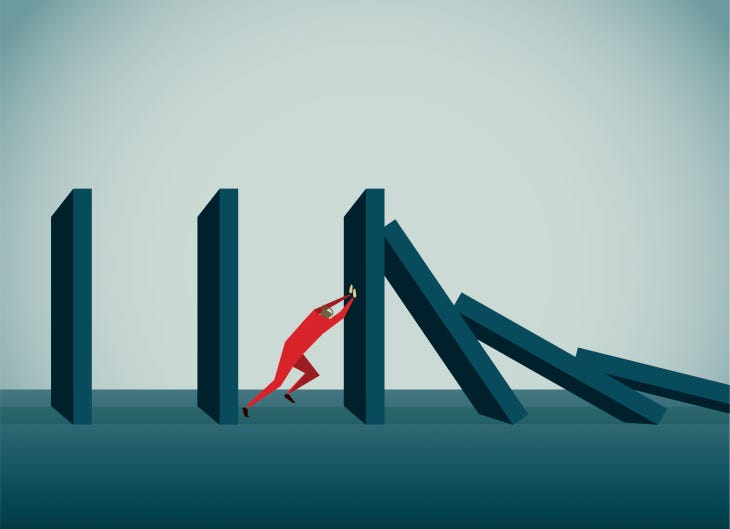
We all have a specific image of resilience: someone who gets knocked down but gets back up and carries on. They remain productive, control their emotions, and put others at ease. Their recovery requires little support from friends, family, or coworkers—which is convenient for those who might otherwise need to provide it.
The person everyone calls ‘the tough one’ may feel obliged to keep handling everything alone, even when they’re exhausted and need help. Praise for their toughness can make admitting any form of distress feel like disappointing everyone. Maintaining that image takes effort—effort that can drain their energy and keep them from accepting support.
After a loss, a breakup, or another major setback, someone who appears resilient may be gradually adjusting to what happened and recovering. They may also be exhausting themselves to hide their distress and maintain the image of resilience others have come to expect. Both can look like strength from the outside. The difference becomes clearer when recovery requires them to change how they cope—such as asking for help when they are used to handling everything alone.
When strength becomes a reflex
Imagine someone whose competence has always served them well. When trouble arises, they organize, research, plan, and anticipate. They know whom to call and which documents to bring. Then their marriage ends. They manage the move, divide the accounts, and make the whole process look effortless.
Six months later, the practical arrangements are settled. Every evening still feels unbearable.
They respond by becoming busier.
Their organizational skills remain useful, but they cannot do all the work recovery now requires. They must acknowledge loneliness, tolerate disappointment, and endure the awkwardness of letting someone see them without a solution in hand.
Asking for support can feel more threatening than handling the entire divorce.
This is one reason resilience is difficult to predict from a list of admirable qualities. Grit, determination, optimism, independence: each can help. Each can also become a response we keep using because we are good at it, long after its usefulness has run out.
Psychologists call the capacity to adjust how we cope coping flexibility. A large research review found that greater flexibility was associated with better psychological adjustment, particularly when people could match their response to what they were facing. That association leaves plenty unexplained, but it gives us something more useful than another instruction to stay positive.1
Consider how often coping advice arrives stripped of the situation it is meant to help.
“Talk about your feelings.”
With whom? At what point? Talking with someone who listens can help you make sense of a painful experience. Repeating the same grievance with someone who keeps feeding it can leave you more agitated than when you started.
“Keep yourself busy.”
For an afternoon, while you wait for news you cannot influence, that might be sensible. For weeks, because every quiet moment brings you into contact with something you refuse to acknowledge, the bill gets larger.
Even emotional restraint has its uses. You may need to finish a difficult meeting before allowing yourself to cry. The trouble begins when the meeting ends and you keep behaving as though it is still in session.
Resilience requires paying attention to these differences. What is happening? What can I influence? What does this particular difficulty ask of me?
You cannot make someone want to stay married. You can decide how to handle the next conversation, whom to ask for help, and whether to spend another evening inspecting their social media for signs of regret. These are different tasks, although distress can bundle them into one enormous verdict: My life is ruined.
In therapy, part of the work is helping a person describe the difficulty precisely enough to respond to it. “I’m falling apart” tells us how overwhelmed they feel. “I haven’t slept properly in a week, and I’m avoiding the friend who keeps inviting me over” gives us somewhere to begin.
That first step toward recovery may feel unimpressive. Accepting dinner. Making an appointment. Delegating something before exhaustion makes the decision for you. Sitting through ten uncomfortable minutes of a conversation you usually escape.
Such experiences matter because confidence has to come from somewhere. Albert Bandura’s work on self-efficacy described how successfully managing a task can strengthen our belief that we can act effectively. A useful belief can grow from something as ordinary as making a difficult call while still feeling anxious.2
Learning from what actually helps
The next part asks for a kind of honesty that self-help slogans tend to skip: noticing what happened after you tried.
Did dinner leave you feeling more connected? Was that particular friend able to listen? Did taking on another project restore some purpose, or simply postpone the same misery until midnight?
A response deserves to be judged by what it produces, including what it costs over time. Immediate relief matters, but so do sleep, relationships, responsibilities, and the gradual return of a life you want to participate in.
When coping becomes an identity
Changing course becomes harder when we have turned our favorite way of coping into an identity. Admitting distress can then feel like losing the respect that toughness has earned us. You might post stoic aphorisms on social media while crying yourself to sleep.
“I’m the one who never needs help.”
“I always push through.”
“I don’t let things get to me.”
These declarations come with their own set of liabilities. Asking for help endangers the first. Resting threatens the second. Admitting hurt threatens the third. Ultimately, maintaining that identity may matter more than addressing the problem.
A psychologist should be interested in what that identity permits, what it forbids, and what it hides.
Someone who has survived by staying quiet may need to learn how to object. Someone who has survived by fighting may need to discover when they are safe enough to stop. Respecting what a response once accomplished gives us a better starting point for changing it.
Resilience becomes an unfair demand when we expect people to recover through determination alone. Someone facing violence, unstable housing, chronic pain, or constant financial pressure must deal with those problems while trying to recover. Safe housing, financial relief, practical support, and access to treatment can make recovery easier. Someone who has that help may recover faster than someone who does not. That difference does not prove they have a stronger character.3
Nor does continuing to suffer establish that someone has failed. Grief and trauma do not follow a timetable set by the people who would prefer us cheerful again.
The useful question is whether there is room to respond differently, with whatever help makes that possible.
For the person who has always been “the resilient one,” that room might first appear in a conversation they cannot organize their way through. Someone asks how they are. They begin the familiar answer, then stop.
“I’m having a hard time. Could you stay for a while?”
For once, the other person gets to do some of the carrying.
Cheng, C., Lau, H.-P. B., & Chan, M.-P. S. (2014). Coping flexibility and psychological adjustment to stressful life changes: A meta-analytic review. Psychological Bulletin, 140(6), 1582–1607. A large review finding an association between flexible coping and better psychological adjustment, especially when responses fit the situation.
Bandura, A. (1977). Self-efficacy: Toward a unifying theory of behavioral change. Psychological Review, 84(2), 191–215. The foundational account of how experiences of successfully managing challenges can build confidence in our capacity to act.
Ungar, M. (2011). The social ecology of resilience: Addressing contextual and cultural ambiguity of a nascent construct. American Journal of Orthopsychiatry, 81(1), 1–17. Drawing mainly on developmental research, this article explains how resilience depends on social conditions and access to resources alongside individual capacities.