

Over the past twenty-five years, technology has revolutionized our lives. We put the world’s knowledge in our kids’ pockets, and sustained mental effort now has to compete with it. Now, with AI, we’re offering to let machines do their thinking for them.
The latest PISA scores are a warning
The latest PISA results need to be looked at closely because trends tell a bigger story once you look past the data.
For those who don’t know, PISA is the OECD's international study of fifteen-year-olds, and it tests whether they can use reading, mathematics, and science outside the classroom. Between 2015 and 2025, average reading scores fell twenty-eight points and mathematics scores fell twenty-two. Science slipped less and held roughly steady from 2022 to 2025. The three subjects are not sliding at the same speed, but reading, the skill that lets a child learn nearly everything else, has taken the worst of it.[1]
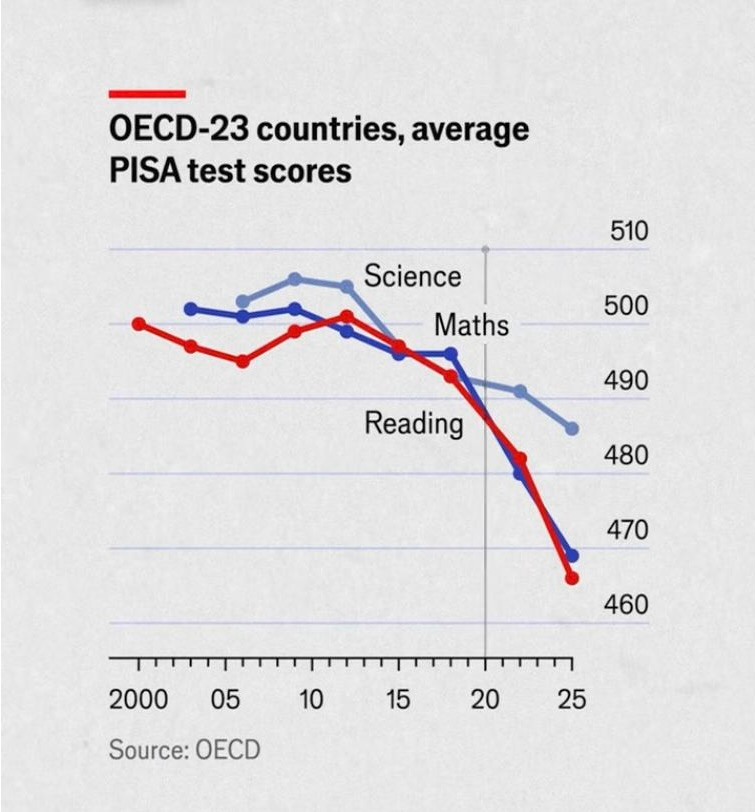
COVID disrupted schools, and it gets blamed for all of this. It did not start the slide, though. Reading and science were already losing ground before the pandemic.[2]
IQ research adds a second worry. The Flynn effect, the steady rise in IQ scores from one generation to the next, has reversed in several populations. A Norwegian study traced both the rise and the fall within families, which points to something in the environment. The decline started in cohorts born long before smartphones existed.[3]
This doesn’t prove that phones make teenagers less intelligent. PISA is not an IQ test, but a falling trend in how well kids can think is bound to have some negative impact. General cognitive ability is one of the best predictors of how well people do at school and in complex jobs. So, if people’s general cognitive ability gets worse over time, it can have a big effect on society. PISA test results show that progress in cognitive abilities is not automatic or guaranteed, and technology can hinder it if it’s misused rather than making kids smarter.
A Childhood of Broken Sentences
As a psychologist, I care about what children practice over and over.
Reading a difficult paragraph means holding one idea in mind while you weigh its opposite. Talking with another person means searching for the right word, noticing that you have been misunderstood, and fixing it. Both ask you to tolerate a short stretch of not yet knowing what you mean. Now picture that stretch cut short, again and again. A child reaches for a screen the moment a problem gets difficult. A parent glances at a notification halfway through an explanation. A teenager drops an awkward conversation for something easier to control, and a permanent lack of focus becomes the norm.
A meta-analysis of forty-two studies linked more screen time to weaker language skills in children, while educational content and watching alongside an adult were linked to stronger ones. What’s on the screen matters, and so does what it replaces.[4] That doesn’t establish a general collapse in children’s verbal intelligence or communication skills, but it does give us reason to protect the experiences that build those skills.
Language is how we make sense of obstacles and hardships. “Everything sucks” and “I felt humiliated when my friends ignored me” invite different responses. Teaching a child to tell them apart is psychological work.
More Connected, More Lonely
The data on the emotional impact is eloquent. In US survey research, parent-reported diagnosed anxiety rose 29 percent and depression 27 percent between 2016 and 2020, and the increases were visible before COVID.[5] In the CDC’s 2023 survey, about 40 percent of US high-school students reported persistent sadness or hopelessness, 20 percent had seriously considered suicide, and 9.5 percent had attempted it in the previous year. Suicidal thoughts and attempts both rose over the decade from 2013 to 2023, though some indicators improved after 2021. The measures are not identical, and the trend is not a straight line down. Still, they describe a great deal of mental suffering.[6]
Blaming screens for all of it would be convenient, but the research isn’t conclusive. Studies of social media and mental health find small, tangled correlations. Vulnerable children differ from one another, and distress itself may push some toward heavier use.[7]
Some mechanisms still deserve attention. Social comparison theory says we compare ourselves to other people. In the past, teenagers compared themselves to their classmates. Now the field includes strangers whose apparently effortless lives took a few photo shoots.
Identity forms by trying new challenges, making commitments, and finding out which choices feel like yours. An identity built on audience approval becomes a performance you cannot stop maintaining. Watch what happens to influencers when their notoriety fades. A systematic review correlated online comparison on social media to identity distress, and authentic self-expression to a clearer sense of self. Online life can support identity exploration as well as complicate it.[8]
No single statistic proves a generation-wide identity crisis. But a serious question remains about growing up while watching yourself be watched.
Loneliness tells a similar story. International school surveys show it rose between 2012 and 2018 in thirty-six of the thirty-seven countries studied.[9] Solitude can restore you; loneliness is the absence of the connections you need. A crowded feed of followers does not guarantee that anyone knows you.
Answers That Hide the Learning
Generative AI adds a different level of hazard. It can hand a child the answer to the assignment before the child has struggled to form the thought. We forget that the struggle is generally the point of the assignment.
In a field experiment with nearly a thousand high-school mathematics students, access to a general-purpose GPT interface improved performance during practice. When the researchers took it away, those students scored 17 percent worse than students who had never had it. A tutor built to protect learning largely reduced the harm. The better answers had been hiding poorer learning.[10]
That distinction ought to dominate the debate about AI in schools. An essay can look polished while its author cannot explain the argument. A fluent summary can cover for the fact that nobody read the text.
Critical thinking requires enough knowledge to spot a weak claim, enough patience to check it, and enough independence to disagree with a confident answer. Hand those jobs to AI before children have learned them, and the child ends up depending on a tool for something never acquired.
A survey of adults by Microsoft researchers found that greater confidence in AI went with less reported critical-thinking effort. It did not show lasting cognitive decline, and it did not study children.[11] The classroom experiment is the more direct warning.
My worry is that widespread substitution will deepen learning difficulties children already have. Predictions that AI will inevitably raise rates of depression or suicide run ahead of the evidence. Still, teaching a child that intellectual struggle always calls for outside rescue builds a poor foundation for confidence. A machine can offer reassurance and the look of competence. It cannot give a child the experience of becoming capable.
Why am I worried? I recently had a very confusing experience in therapy. During a session, a twenty-year-old patient read out the answer ChatGPT had just generated to a simple question I asked him. He didn’t have the words or the confidence to express his thoughts and emotions without the help of AI. I can clearly see the start of a much bigger problem on the horizon.
Let Kids Do the Hard Part
Telling children to build better digital habits while adults arrange their own lives around convenience will not work. Something more substantial is needed. Protect uninterrupted reading. Make room for conversations that wander and for disagreements that have to be resolved. Let children try a problem before they ask for the answer. When AI enters the classroom, require students to explain the result, check it, and defend it.
Adults belong in this arrangement too. We cannot defend attention convincingly while checking our phones in the middle of a child’s sentence.
Children need help, teaching, and sometimes therapy. They also need to find out for themselves: I was confused, I stayed with it, and I understood. That is how competence becomes something they can trust.
The most valuable thing a child brings home from school is not a finished assignment. It is a mind a little better able to manage without help, and a little more sure of what it can do.
Sources
Madigan et al. (2020), Screen use and child language skills: meta-analysis
Lebrun-Harris et al. (2022), Trends in US children’s health, 2016–2020
Social media use and adolescent mental health: umbrella review (2026)
Social media use and adolescent identity development: systematic review
Twenge et al. (2021), Worldwide increases in adolescent loneliness
Bastani et al. (2025), Generative AI without guardrails can harm learning
Lee et al. (2025), The impact of generative AI on critical thinking