

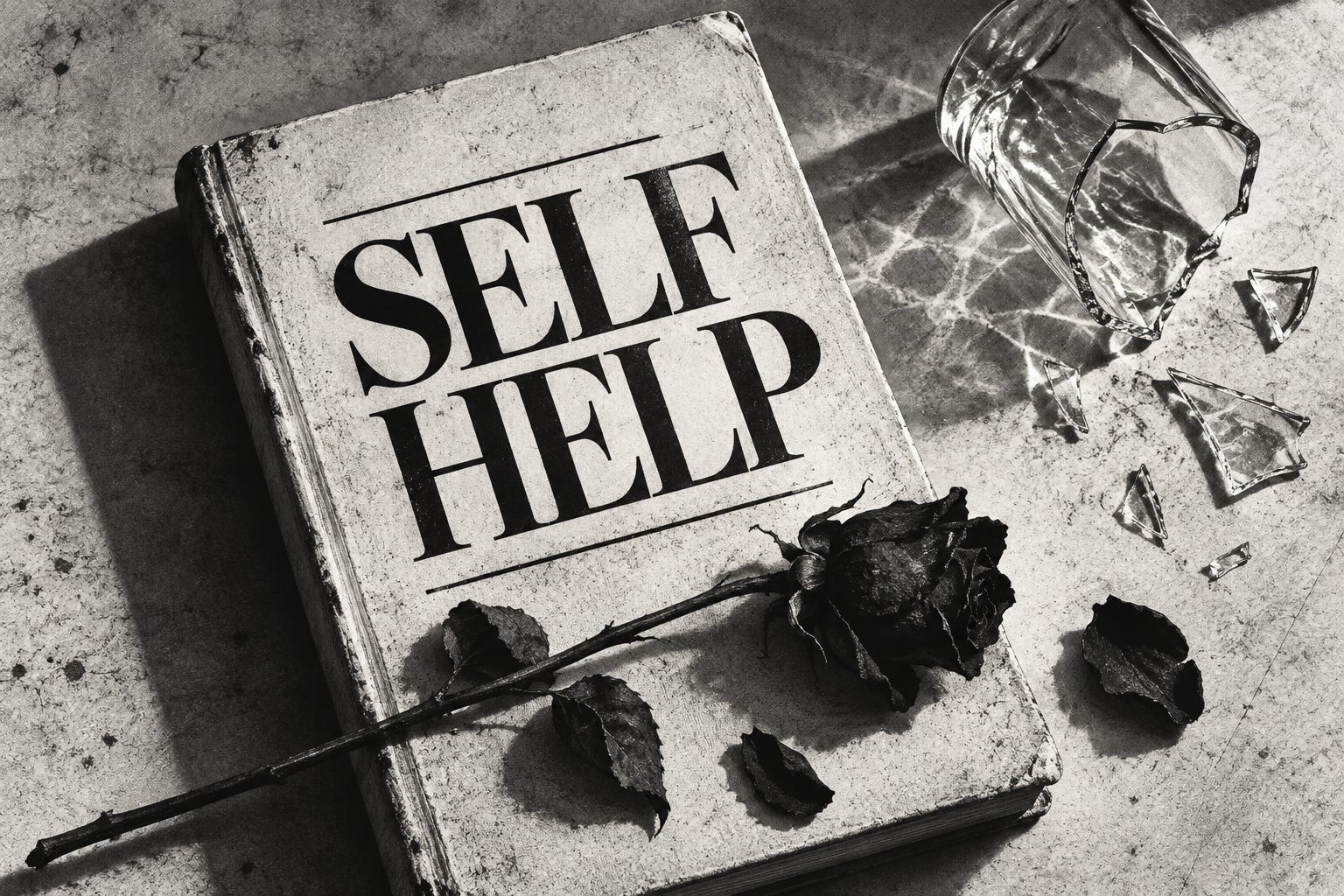
There’s a particular type of person who wakes up at 5:45 a.m.—not 6:00—because their sleep-tracking app told them that’s the optimal moment in their REM cycle. Once up, they drink 16 ounces of room-temperature lemon water (cold water impairs digestion, while hot water destroys enzymes). Then, exactly 90 minutes after waking, they drink a carefully timed black, sugarless coffee to maximize cortisol efficiency. Next comes the ice bath, followed by light therapy, breathwork, and journaling with the $80 pen that enhances neuroplasticity.
By 7:15 AM, they’ve completed their entire wellness protocol.
By 7:30 AM, they’re scrolling through YouTube, wondering why they feel empty.
Welcome to the optimization trap. The peculiarly American delusion that if we just find the right sequence of biohacks, morning rituals, and productivity systems, we’ll finally unlock the secret door to a meaningful and healthy life.
We won’t.
Meaning is slippery. A morning routine with a checklist creates the illusion of control. If you’re disciplined enough, you can complete the checklist without ever figuring out why you’re putting yourself through all this. Health is a daily set of smart choices that compound over time and have more to do with common sense than with biohacks.
When self-care becomes a second job
I see this constantly in my therapy practice. Successful people—genuinely accomplished, smart, thoughtful individuals—who’ve turned self-care into a second job. They track their macros, monitor their heart rate variability, fine-tune their supplement stacks. Yet, they still show up in my office asking why they can’t shake a pervasive sense of disconnection that’s turning into a depression.
The answer is usually simpler than they want to hear: You can’t hack your way out of loneliness.
You can improve your sleep and still have nobody you feel safe calling when your life falls apart. You can get stronger and remain terrified of being known. You can have an athlete’s resting heart rate and be in a relationship where neither person ever says anything that matters.
The habits may be helping. They just can’t do all the work we’ve assigned them.
The clue to the problem lies in its name.
The self-help industry is based on the appealing and marketable idea that with enough discipline and the right tools, you can achieve well-being on your own. No community required. No vulnerability necessary. No need to accommodate any messy, inconvenient “other people” either. (Other people are inconvenient; they rarely respect your optimisation schedule).
The comfort of a measurable problem
There’s a sneaky reason why this self-help narrative is so appealing.
It has to do with control and the obsessive delusion that comes with it. A workout routine has an end. A difficult conversation does not. A sleep score gives you a number to work with. Grief gives you an ordinary afternoon when you suddenly can’t stop crying in the supermarket.
Faced with that choice, many of us opt for the measurable stuff. Wellness hacks create an artificial sense of contentment by giving you the illusion that you are fully in control of your life. Ultimately, the hacks end up controlling you.
Many of these practices do have value—although the real benefits are often marginal and oversold. Moderate exercise, a healthy diet, meditation, and decent sleep can make a real difference. Cold showers may reduce post-exercise soreness and boost dopamine. Meditation has genuine neurological effects. Fine.
What I’m interested in knowing is what happens when those useful habits become a way of staying busy around the edges of your life.
The meditation app says you’ve completed 149 consecutive days. Congrats.
But can you listen to your partner when they tell you they’re unhappy, without immediately explaining why they shouldn’t be? Can you acknowledge that you’re hurt without turning it into a personal development project? Can you spend an afternoon doing something you enjoy without trying to improve your brainpower, extend your lifespan or create content? Can you tolerate the fundamental uncertainty of existence without resorting to elaborate systems that create a false sense of control and ease your existential angst?
These questions are tough to answer. There’s no streak to maintain, no dashboard to consult, no KPI to measure, and usually nobody handing out a badge.
This is where self-help can turn into emotional avoidance, complete with great branding and carefully curated social media feeds designed to seek external validation. We feel productive because we’re doing something challenging. Meanwhile, the conversation, grief or admission that we have been putting off remains exactly where we left it.
I’m not against these practices. I’m against what we’ve made them into—shields against genuine self-examination, participation trophies for emotional avoidance.
Who put the guru in charge?
We’ve also become strangely willing to confuse achievement with wisdom. Expertise in one domain doesn’t always translate to wisdom about living.
It’s the expert fallacy. Just because someone is on a podcast or wrote a book doesn’t mean they’re an expert on how the rest of us should live. A neuroscientist can explain the mechanisms of dopamine regulation but still have no idea how to navigate a failing relationship. A successful entrepreneur can build a billion-dollar company while being emotionally stunted, incapable of forming healthy relationships, and unable to apologize to their kids.
Yet we’ve created this bizarre cultural equation where achievement equals authority on human flourishing.
Competence deserves respect. It also has boundaries. But today, once someone becomes sufficiently successful, they get invited to explain everything: work, marriage, parenting, happiness, and the correct temperature of our shower.
The self-help industry is glad to accommodate.
It transforms someone else’s experience into a universal formula and sells us the formula or its byproduct. It does so as if the complications of being human required a sophisticated features-benefits analysis.
Your depression may need the care that a productivity system cannot provide. Your anxiety may persist despite a carefully managed wellness routine. Your sense that something is missing in your life may deserve more attention than another podcast on stoicism.
Advice can be helpful. It can also keep you busy applying somebody else’s answers to questions you haven’t properly asked yourself.
“What should I do?” is useful.
So is “Why am I so determined to become this particular kind of person?”
And, occasionally, “Whose approval am I still trying to earn?”
That last one tends to spoil the mood at the biohacking conference.
A better self?
It’s revealing how solitary and, at times, narcissistic our vision of improvement has become.
My routine. My goals. My boundaries. My growth.
All are legitimate concerns. But taken together, they can create a life in which everyone else exists on the periphery of one very well-managed individual.
There’s a connection here to our broader cultural moment. This obsession with personal optimization mirrors our political dysfunction perfectly. Both stem from the same underlying pathology: the belief that our individual freedom matters more than our collective responsibility.
Humans are deeply social creatures. Our nervous systems literally co-regulate with others. Our identity is defined by human interactions. We evolved to be interdependent, not independent. The idea of the self-made, self-optimized individual is a myth. And it’s making us unhealthy.
We can spend two hours preparing ourselves for the day and have no time left to learn our neighbor’s name. We can become fluent in the language of boundaries while losing the ability to distinguish an unreasonable demand from the ordinary inconvenience of caring about someone.
Relationships require things optimization culture doesn’t always know what to do with: patience, compromise, interrupted plans, giving without an immediate return. A friend in trouble may need the evening you had reserved for recovery. A child may have no interest in your deep-work window. Loving someone will occasionally make you inefficient.
The question is whether we’ve built lives with enough room for that.
Because connection requires participation. You have to show up, sometimes tired, sometimes distracted, sometimes without having completed your protocol.
What I’ve seen change people
In my work as a therapist, I rarely see positive lasting changes begin with someone discovering a better wellness routine.
Positive changes arise from pain. Not the manufactured pain of an ice bath, but the genuine discomfort of confronting the difference between who you are and who you pretend to be. The pain of admitting you’ve been hiding. The pain of realizing your defenses no longer serve you. The pain of sitting with grief, rage, shame, or fear without trying to immediately fix, optimize, or transcend them.
Pain itself isn’t the achievement. What matters is becoming willing to face something hard you’ve spent a long time managing around.
It begins with truthful admission: “I’m lonely.” “I’ve been hiding.” “I don’t know how to ask for what I need.” “I’ve spent years trying to become someone nobody could reject.” “I wish my dad could see me for who I am”.
Change happens in a relationship—with a therapist, a partner, a genuine friend who won’t let you bullshit them. It happens when you stop performing and start being. When you trade the curated Instagram version of your life for the messy, contradictory, beautifully human reality.
The people I’ve seen make real shifts are the ones who stop asking, “What should I optimize?” and start asking, “What am I avoiding?” They stop trying to optimize their external circumstances and start examining their internal landscape. They trade productivity porn for genuine introspection. They ask questions that are less marketable but can actually get them somewhere.
No five-step plan, unfortunately
At this point, I’m supposed to offer “Five Simple Steps to Authentic Living,” ideally with a downloadable worksheet.
I have disappointing news.
But I can tell you this:
Pay attention to what you’re using your optimization rituals to avoid. Notice when those practices become elaborate forms of procrastination. Ask yourself if your obsession with personal improvement is actually a sophisticated form of self-rejection—the belief that you aren’t good enough the way you are.
Start by noticing what happens when you miss one of your daily rituals. Are you mildly inconvenienced, or do you feel you’ve failed as a person?
Maybe you should allow yourself to be loved and feel worthy before becoming more disciplined. Maybe you should unfocus on yourself for a moment and instead focus on being generous and present toward others. Maybe an afternoon can be worthwhile even if it doesn’t produce a measurable benefit. Maybe you could enjoy something without adding another notch on your personal development scoreboard.
Maybe it’s in the conversation you’ve been avoiding with your partner. Or the friendship you’ve let atrophy because you’re too busy optimizing. Or the simple, untracked pleasure of doing something for no reason except that it brings you joy.
Try this instead: Waste some time. Be inefficient. Allow yourself to be vulnerable. Have a long, meandering conversation with someone who goes nowhere. Call the friend you keep meaning to call. Have the tough conversation you’ve been avoiding with your partner or your kid. Try to sit still without tracking your heart rate variability.
There will always be another habit to adopt, a new app to try, another metric to improve, another person online explaining what you’re doing incorrectly.
Meanwhile, your life is happening. Some of it is slipping by and needs your attention more than your improvement. It’s a human reality to be inhabited with presence, humility, and connection.
Your morning routine can wait.