

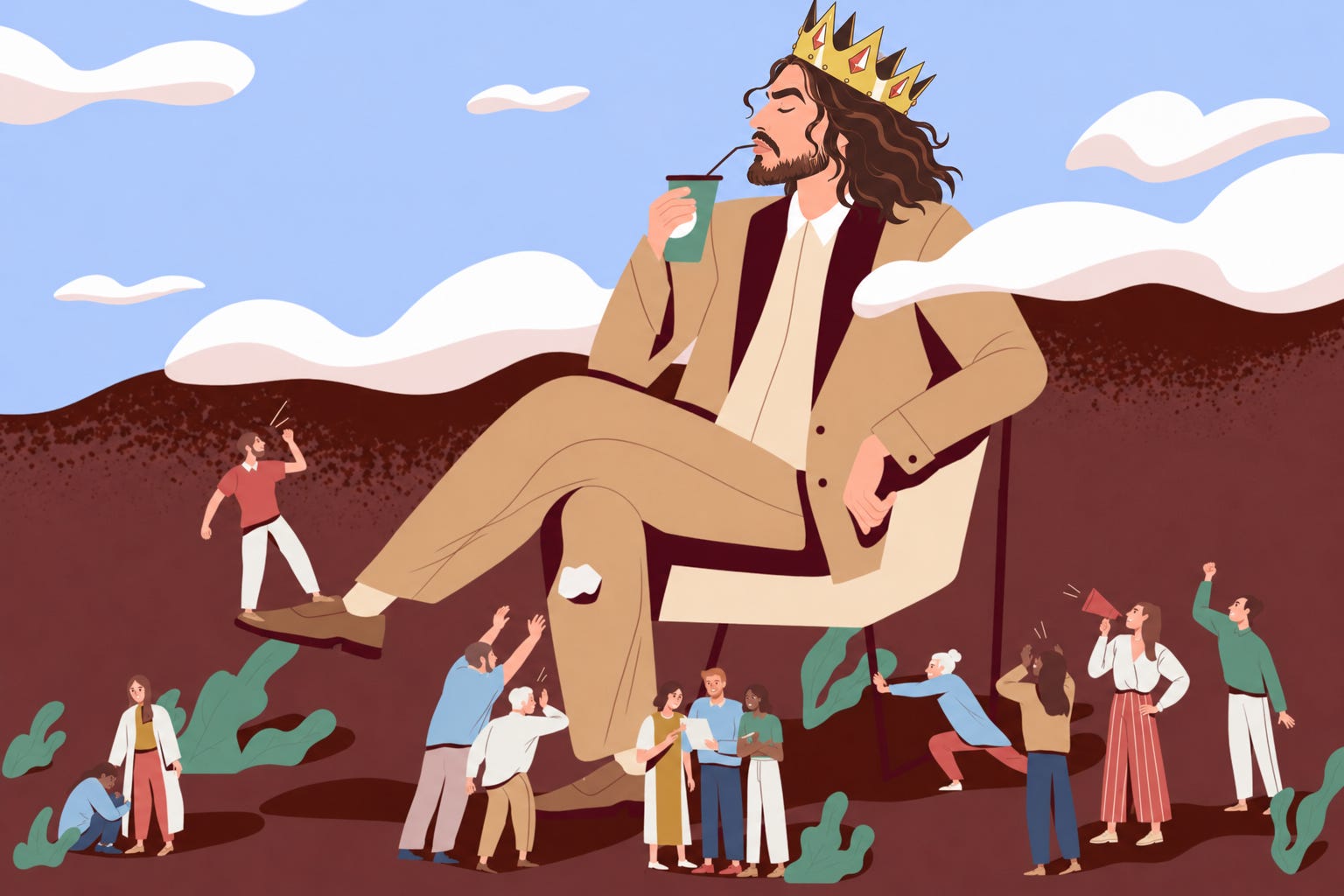
Russell Brand’s sentencing today at Southwark Crown Court in London has renewed scrutiny of the man behind the performance.
Among the descriptions circulating around him, one keeps returning: narcissist.
Former friend Gordon Smart has used it. His former assistant, Helen Berger, described a man absorbed in himself. Brand has used the word too: in a 2014 Howard Stern interview, he called himself “an egomaniac and a narcissist.”
So what is this term describing? A man with an oversized ego? A personality disorder? Or something more useful to understand than either an insult or a diagnostic label?
In this post, I’m discussing a psychodynamic interpretation of Russell Brand’s public behavior, not offering a clinical diagnosis. The PDM-2’s account of the narcissistic personality style offers a deeper understanding of the emotional needs and inner conflicts that can give rise to behaviors like Brand’s.
Needing to remain exceptional
In my earlier writing on narcissism, I argued that the word loses its usefulness when it becomes shorthand for anyone selfish, vain, or unpleasant. Russell Brand brings that distinction into sharp focus.
Someone can enjoy attention without depending on it to feel worthwhile. They can be flamboyant without needing everyone else to become supporting characters.
The PDM-2 (Psychodynamic Diagnostic Manual, 2nd Edition) is a major reference for psychodynamic clinicians. It complements symptom-based classification by examining personality, mental functioning, and subjective experience—including attachment, defenses, self-esteem, and relationships. It distinguishes personality style from severity.
The central concern with the narcissistic personality is maintaining a tolerable sense of self-worth. Narcissistic concerns can organize a person’s life with varying degrees of flexibility, distress, and damage to relationships. According to psychologist Nancy McWilliams, there is a tension between inflated and deflated self-esteem, with shame, humiliation, envy, and contempt often lurking nearby.1
As narcissistic defenses become more rigid, being exceptional starts to feel like a psychological necessity. Admiration brings relief. Criticism threatens to expose something painful. Another person’s indifference can feel worse than their dislike.
Grandiosity serves a purpose here. It helps keep feelings of inadequacy, dependence, or insignificance at a distance. The person who fills every available inch of a room can still struggle to feel substantial within it.
When identity becomes a livelihood
Russell Brand built a recognizable public identity around verbal brilliance, sexual excess, extravagance, and a talent for taking over an encounter. The hair, clothes, rapid-fire delivery, and relentless sexual references belonged to a stage character whose appeal depended on being gloriously unrestrained.
Over time, the sexual provocateur became a political commentator, then a spiritual figure. Each reinvention offered a fresh story through which to explain himself, shifting attention toward who he was becoming and away from responsibility for his behaviors.
The persona also became a livelihood. Audiences expected outrageousness. Employers bought it. Publicity rewarded it.
With a surname like Brand, the marketing almost wrote itself. But the coincidence carries psychological weight: the name, the public image, and the demand to remain exceptional become bound together. The trap begins when the man can no longer afford to step out of character.
Consider the psychological possibilities. If desirability steadies your self-esteem, sexual attention becomes reassurance. If commanding the room protects you from feeling insignificant, sharing that room becomes difficult. If ordinary limits threaten the identity people pay to see, ignoring them can start to feel like staying true to yourself.
The trouble deepens when other people become material. In the Andrew Sachs broadcasts, Brand and Jonathan Ross turned intimate information about Sachs’s granddaughter into entertainment. Ofcom found that the broadcasts unwarrantably infringed both her privacy and Sachs’s.2
The joke depended on treating someone else’s intimate life as available for use. A narcissistic reading draws attention to precisely that failure to give another person’s reality sufficient weight.
How applause becomes permission
Stardom can create an environment in which a person’s wishes receive an extraordinary amount of accommodation. Doors open. Schedules change. Other people handle the awkward conversations.
For someone whose self-esteem depends on being special, that accommodation can begin to look like confirmation that different rules apply.
Russell Brand’s case also exposes the institutional part of this story. Channel 4’s review identified shortcomings in handling a complaint about his conduct toward a staff member. An organization’s failure to enforce limits can reinforce the expectation that limits are negotiable.3
Add a public identity organized around sexual libertinage, and the consequences become easier to understand. Being desired becomes evidence of worth. Repeated sexual attention confirms the story. A refusal threatens both an immediate wish and the identity invested in its fulfillment.
The internal logic can shift from “People want me” to “This person should want me.” Desire acquires the force of a demand and becomes a sense of entitlement.
Research gives this argument substance. In experiments, Jonathan Kunstman and Jon Maner found that power could increase expectations and perceptions of a subordinate’s sexual interest under particular conditions. Research on sexual narcissism has also linked sexual entitlement, exploitation, and low sexual empathy with sexual aggression.4
These findings identify risks, not destiny. The relevant concern is the combination of entitlement, power, and disregard for another person’s wishes—not how many partners someone has.
Making room for an unwanted answer
Respecting consent requires accepting that your desire gives you no authority over another person’s body. An entitled person may understand this intellectually while resenting it emotionally. Hesitation becomes coyness. Refusal becomes a challenge. Persistence gets dressed up as seduction. The distortion lies in treating one’s own desire as evidence of the other person’s willingness.
Admiration does not establish willingness. Access does not establish willingness. Someone can find you fascinating, attractive, or important and still decline intimacy.
A narcissistic personality style can help explain how rejection becomes associated with humiliation, and how defending self-esteem can become an attempt to control the person saying no. Understanding this process clarifies responsibility: experiencing distress at a boundary does not give someone permission to cross it.
When the public stops applauding
The recently released police interviews show a subdued Russell Brand, far removed from the expansive performer we’re familiar with. Recorded during the investigation, they place him in an encounter whose pace and purpose he does not control.5
The contrast is striking. Onstage, charisma helps him shape the encounter and transform discomfort into a performance. In the interview room, someone else sets the terms.
Psychodynamically, the question is what remains available to someone when the familiar ways of sustaining their self-esteem stop working. Grandiosity can mask distress, feelings of emptiness, and vulnerability; losing its protection can be destabilizing.
There is room for empathy here. A person can have real talent, experience substantial suffering, and exhibit behaviors that are damaging to themselves and others. Understanding their suffering does not absolve them of responsibility for the harm they cause.
Charisma and grandiosity can conceal narcissistic vulnerability. When public success rewards the performance and those around the star stop enforcing limits, the behaviors defending that fragile sense of self can become more entrenched, entitled, and damaging. Admiration begins to function as validation: what wins applause must be acceptable. The danger is that success reinforces the patterns the person most needs to confront.