

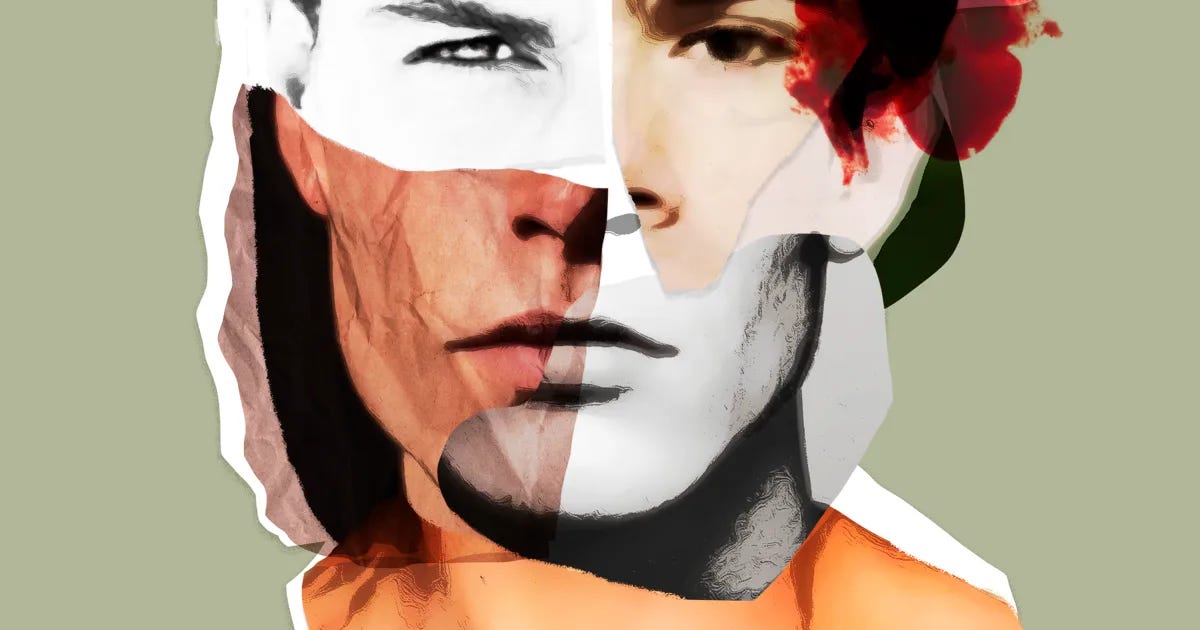
The face you were born with is not the real you. The one you paid for has a better claim. The problem with looksmaxxing is not that it takes appearance too seriously—it is that it does not take the self seriously enough.
The neologism looksmaxxing comes from incel online subcultures where young men trade aggressive protocols for improving their appearance. But the phenomenon it names is older, larger, and not remotely confined to them. In Seoul and Shanghai, double-eyelid surgery is a graduation gift. Seoul’s Gangnam surgical district runs at industrial scale. Chinese livestreamers refine their faces in real time through filters, training a generation of young women to see their unretouched selves as deficient. Western teenagers absorb the same grammar through Instagram and TikTok. The subculture has produced its own celebrities—figures like Clavicular, whose authority rests entirely on his face and the protocols that produced it. It’s a closed loop where the credential and the product are the same thing. Looksmaxxing is the term for a global phenomenon: the widespread belief that one’s appearance is a draft that must be revised.
The subculture distinguishes between softmaxxing and hardmaxxing. The soft version is unremarkable: lift weights, fix your teeth, find a haircut that suits your skull. The hard version edges toward the baroque—jaw implants, limb-lengthening surgery, bone smashing regimens in which young men strike their own faces with hammers to reshape the underlying bone. These are pursued with the fervor of religious observance. Dismissing the whole enterprise as vanity misses what is really happening. Looksmaxxing is a folk philosophy about agency, fairness, and the self, dressed up in gym clothes or clinic gowns.
Consider the paradox it stumbles into. The face you were born with—the one arranged by a genetic lottery you did not enter—is treated as the “real” you. The jaw you sculpted through years of discipline, or the nose you paid a surgeon to refine, is treated as fake. But which actually reflects your intentions, your choices, your values? The inherited face is an accident. The modified one is an argument. From a narrative standpoint, the deliberate version claims greater authenticity because it was authored rather than received.
This is the problem classical notions of the natural self cannot solve. We praise people for losing weight, learning languages, quitting drinking, and going to therapy. Each involves overriding something given in favor of something chosen. Nobody suggests that a person in recovery is less authentic than the version who was drinking. Yet applying the same logic to a cheekbone shifts the moral temperature. The lines we draw between acceptable and suspicious self-modification—fitness yes, filler no; orthodontia yes, rhinoplasty maybe—do not trace any consistent principle. They trace what we are used to.
The pressure behind all this is not imagined. Economists have documented a beauty premium for decades. Attractive people earn more, get hired faster, receive lighter sentences, and are judged more trustworthy by strangers in experiments. The effect is modest per interaction and enormous in aggregate. Telling someone their appearance does not matter is, in most contexts, a lie told for their comfort. Looksmaxxing is right that the stakes are real. But it gets almost everything else wrong.
Here, the clinical picture sharpens. In the consulting room, the patient who has reorganized life around appearance tends to share a structure. There is an early wound, often a humiliation, frequently involving being seen and found wanting. The wound gets localized onto a feature—the nose, the hairline, the jaw, the eyelid, or the breast. That feature becomes the explanation for everything that has gone wrong since. The chosen feature is usually culturally assigned. The man who has absorbed the manosphere lands a blow to his jaw. The young woman, in a culture that rewards a particular eye shape, sees it in her own eyelids. The patient in São Paulo has different coordinates from the patient in Seoul. The feature differs; the structure does not. Fix the feature, the reasoning goes, and the life corrects itself. The logic has the elegance of a delusion: internally consistent, empirically sealed off.
What this structure accomplishes is important to name. By routing every disappointment through the body, the patient avoids more demanding self-examination of behavior, relationships, avoidance, and ability for intimacy. The body becomes a displacement. It is easier, perhaps, to spend three years and thirty thousand dollars on a face than three weeks learning to tolerate being disliked. Psychodynamically, looksmaxxing in extreme form operates as a defense. It keeps a more frightening question away: if I looked exactly as I wished, would I still be afraid to be known?
The displacement carries different freight depending on who is doing it. For the young man routing his rejections through his jaw, the fantasy is usually about status and sexual access. For the young woman routing hers through her eyelids or nose, the fantasy is more about visibility, worth, and being chosen. In many East Asian contexts, it is also about marriageability and family mobility. These pressures are transmitted, not invented. The cultural script differs. The maneuver is the same: take a diffuse, unbearable question about whether one is lovable and compress it into a surgical problem with a price tag.
This does not mean the practice is pathological in every form. There is a version that functions as real agency. Someone refuses to let an accident of birth dictate social fate, takes reasonable steps to present themselves well, and gets on with life. Here, philosophers would say, one is authoring oneself. Softmaxxing, kept in proportion, is closer to this. Yet the activity pulls participants past this point. Early gains yield high returns—basic grooming, fitness, and decent clothing produce dramatic improvements. Once those are secured, each further gain costs more and delivers less. Hardmaxxing is where the curve flattens and the investment steepens, and where the displacement structure tends to take over.
One is also chasing something that cannot be measured. Unlike a stock portfolio, you cannot run a regression on your new chin’s dividends. Feedback about appearance is noisy, social, and scattered over many variables. Clarity resists measurement. As a result, the pursuit tends to expand to fill whatever space it is given, since no outcome can conclusively disprove the need for more.
There is a further wrinkle, and it is the one worth sitting with. Human social judgment runs in two stages. Appearance dominates the first—the glance across a room, the swipe, the opening seconds of an interview. Once more information is available, appearance recedes, and deeper traits take over: competence, warmth, humor, reliability, the capacity to be present with another person. Looks open the door. What is behind the door decides everything else.
And there is a final irony that the subculture rarely sees. Beauty derives part of its value from its scarcity. If every face could be engineered to the same specifications—and the technology is headed that way, in clinics and on camera filters alike—the currency inflates and collapses. What becomes rare, and therefore valuable, are the traits that cannot be purchased: a genuine voice, a developed mind, the particular gravity of someone who has done the interior work. The market for faces is racing toward saturation. The market for selves is not.
The looksmaxxer is right that the self can be authored. He has simply chosen the shortest book.
“deeper traits take over: competence, warmth, humor, reliability, the capacity to be present with another person” — yes, I hope we still do live in a world that looks beyond appearances. Sociopaths are having a field day with fly-by-night, low accountability, unable-to-test-character-long-term “village” mimicry. Where are the old interconnected extended families who judged character by witnessing words and behavior over decades? We’ve decided to ditch communities that could judge character, and seem to have traded them for communities of appearance and virtue signal .