

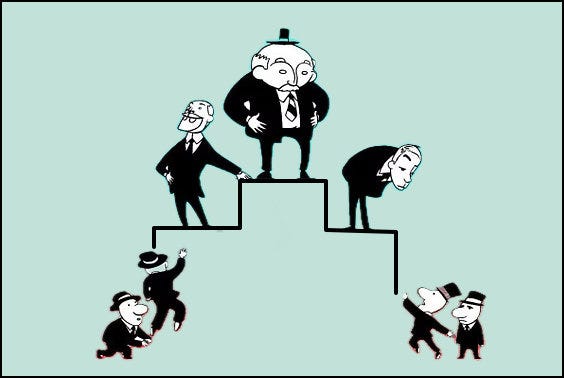
Status doesn’t announce itself. It quietly governs most of what you do, while you convince yourself you’re driven by something nobler.
That discomfort you felt when a colleague’s salary leaked and yours looked modest by comparison—that wasn’t really about money. The LinkedIn profile you spent forty minutes editing before posting, the neighborhood you cite when someone asks where you live, and the name-dropping that creeps into conversation when you feel slightly outgunned in a room: none of that is about resources. It’s about the value other people assign you. Your nervous system monitors this value with ruthless efficiency.
Social status is, in evolutionary psychology, a fundamental human need. It’s not just a personality quirk or a shallow ambition. It is a drive as old and biologically serious as hunger. The psychologist Michael Gazzaniga observed that when the mind is left to wander—no task, no external pressure—it defaults to thinking about social relationships: where you stand, who respects you, how you’re perceived. So when the brain rests, it does’t go blank. It thinks about the org chart. Neuroscientists call this the default mode network. They found that this idle state overlaps almost entirely with the brain regions active during social evaluation.
This matters because we tend to tell flattering stories about our own motivations. We pursue better jobs because we’re ambitious. We want to live in a certain zip code because the schools are good. We follow a particular crowd because we share their values. These explanations aren’t necessarily wrong—they’re just incomplete. Running quietly underneath them is a status calculation that predates conscious thought by several hundred thousand years.
Two ways to the top—and one of them is a trap.
According to the dual strategies theory of evolutionary psychology, humans can increase their status in social hierarchies using two major strategies: dominance and prestige. These two distinct routes to social status operate through completely different psychological mechanisms. The dominance strategy operates through fear: people comply because the costs of not complying are too high. Prestige, on the other hand, operates through admiration: people gravitate towards you because of what you can offer them, such as knowledge, skill, access and reflected esteem. While both routes broadly lead to the same destination, they have radically different processes.
Dominance is evolutionarily older. You see it throughout the animal kingdom—ritualized combat, submission displays, threat hierarchies among chimps and wolves. Among humans, it tends to cluster with narcissism, aggression, and what personality researchers identify as disagreeableness—a personality trait. It’s the manager everyone hates, but nobody challenges—not out of respect, but because he controls the holiday schedule. It’s the political leader who rules by keeping people anxious. And crucially, it’s unstable: dominance-based status requires constant maintenance, generates resentment, and tends to collapse—sometimes quickly, sometimes violently. Psychologist Jessica Tracy notes that dominant people pay for their status by incurring active dislike from those around them. That price compounds over time.
Prestige is the more interesting phenomenon and the more characteristically human one. It’s freely conferred. Nobody is coerced into admiring a brilliant scientist or a gifted athlete. No one forces respect for an unusually wise teacher. You extend that admiration because it feels right—because the person has done or knows something you value. Some part of you calculates that being close to them is worth something. When Angelina Jolie wrote about her genetic cancer risk in a newspaper op-ed in 2013, the number of women seeking screening spiked measurably. That effect lasted for months. She has no medical training. What she has is prestige. Prestige works as a signal amplifier. It makes the message louder, no matter the channel.
This is also, incidentally, why someone with millions of followers gets asked for their views on geopolitics. The brain sees “this person receives a lot of attention” and concludes “therefore they probably know things.” Our status-detection system evolved to read genuine signals in small communities. It wasn’t built for the scale or the artifice of the modern attention economy. A person who earns millions of views eating food on YouTube acquires the attention architecture of prestige. They may lack the underlying competence that originally warranted it. The system, embarrassingly, can’t always tell the difference.
The math our ancestors ran
For most of human history—the overwhelming majority of it—people lived in small, mobile groups of about 150. Everyone you would ever meet was someone you’d meet again. Reputation wasn’t a social asset; it was a survival asset. Status determined access to food, allies, and mates, and evolutionary pressure selected hard for the psychology that pursues it.
The anthropologist Christopher Boehm documented how hunter-gatherer communities, far from being dominated by powerful alphas, tend toward a striking egalitarianism. They developed status-leveling mechanisms—social tools for keeping any one person from rising too far. The would-be bully was mocked, excluded, and when that failed, eliminated through coordinated action. This, according to evolutionary biologist Richard Wrangham, is part of how we domesticated ourselves. The most impulsively aggressive males were gradually weeded out. What remained was a species capable of extraordinary in-group cooperation—and, as the cost of that cooperation, extraordinary capacity for organized violence against out-groups. We tamed ourselves to be gentle with each other and more dangerous to everyone else.
The part nobody wants to admit
Status isn’t just about how you feel at a dinner party. It tracks health outcomes. People with high sociometric status—meaning they are well-liked and respected in their social world, regardless of income—show lower rates of depression, anxiety, and chronic illness. The correlation between well-being and social rank among peers is stronger than the correlation between well-being and income. In developed countries, once survival is no longer a daily concern, people mostly want to matter to those around them.
What’s clinically striking is how invisible this drive tends to be. People rarely walk into a therapy session and say, “I think I’m in a status crisis.” They say they feel disrespected, overlooked, and undervalued. They feel that their contributions aren’t recognized. They feel embarrassed for reasons they can’t quite articulate. The sociometer—the term psychologists use for the internal system that monitors social acceptance—doesn’t send its signals in language. It sends them in emotion. Shame, embarrassment, the peculiar sting of being left out of a conversation: these are the sociometer’s alerts. They feel personal and idiosyncratic, but they follow a remarkably consistent logic.
The Cyberball experiment makes this almost uncomfortably clear. Participants were excluded from a digital ball-tossing game for two minutes. They played with strangers through a screen on a brief, pointless task. Still, participants reported significant declines in self-esteem, meaning, and belonging. Just two minutes with a cartoon ball and complete strangers led people to tap the screen trying to get back in. If you needed evidence that the status drive doesn’t do nuance, there it is. The researchers found this effect held across personality types. Being excluded is a strong social-psychological situation. It overrides individual differences and produces the same response in almost everyone.
That reaction isn’t weakness or sensitivity. It’s the correct response for an organism that evolved in a world where every social interaction carried real stakes. In that world, every person in your group was someone you’d deal with again tomorrow—and the next day. The logic still runs even when the context has changed.
The gap between knowing and being free of it
Understanding the machinery doesn’t disable it. Knowing that the envy you feel toward a colleague’s recognition is a status response, shaped by evolution, doesn’t make the envy vanish. This knowledge can give you distance. The feeling is still there, but you’re no longer completely identified with it. That step is where self-knowledge actually begins. The work is not to eliminate these drives but to see them clearly, so they don’t simply operate through you without your awareness.
Most people are governed by status concerns they deny having. That gap—between what we do and what we believe we’re doing—creates unnecessary suffering. Wanting to matter isn’t shameful. The issue is that when we can’t see what we want clearly, we can’t choose wisely what to do with it.