

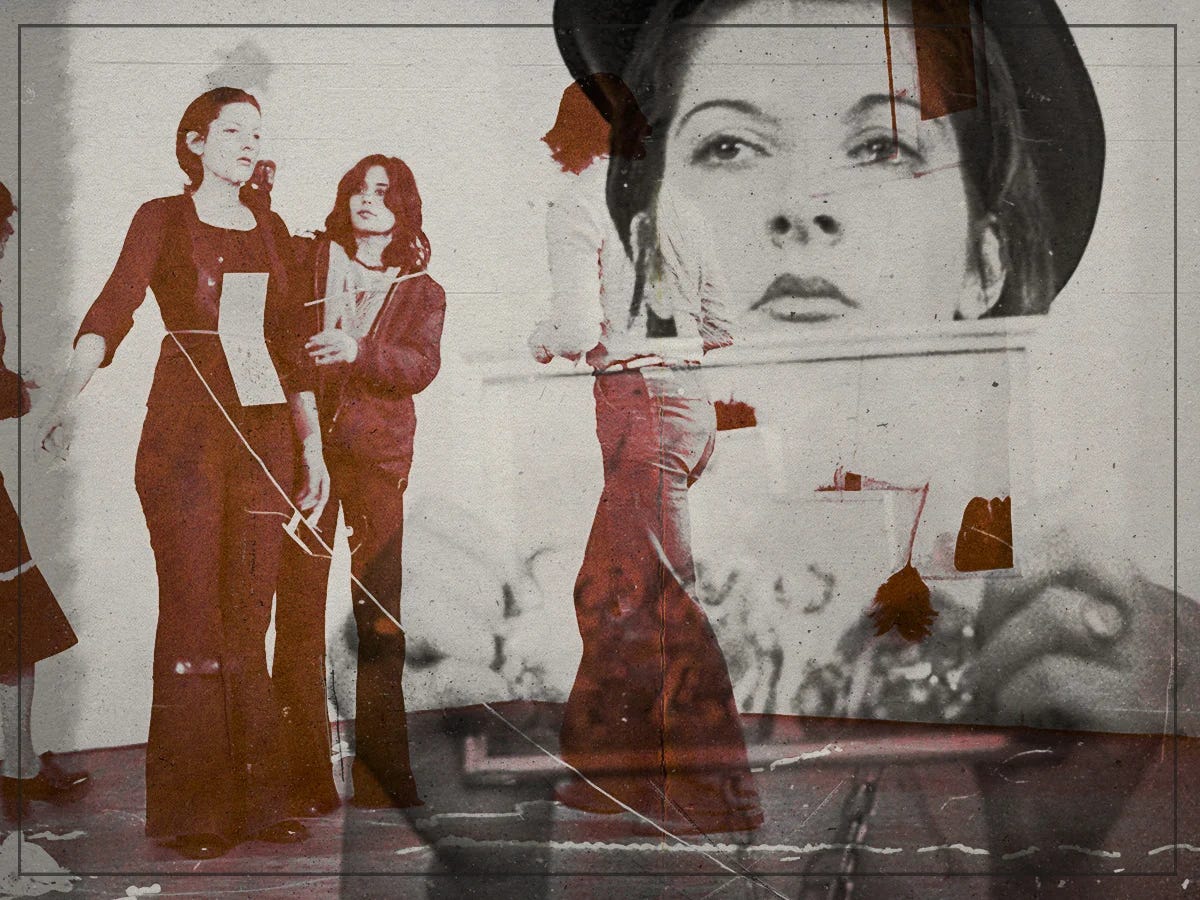
Someone cut off her clothes with scissors. Someone else used a knife to trace a bloody line along her throat. A third person loaded the gun.
It was 1974 in an art gallery in Naples. Marina Abramović stood perfectly still for six hours while strangers did whatever they wanted with her body. She had placed 72 objects on a table—a rose, a feather, honey, wine, scissors, a whip, and a loaded gun—and had invited the audience to use them however they wished, without consequences. She would not move. Nor resist. She would not protect herself.
By the end, her shirt had been slashed open. Someone had carved into her skin. Tears streamed down her face while she remained motionless. The loaded gun was pressed against her neck, her own finger placed on the trigger, held there by someone else’s hand. When the performance ended, and she finally moved, the crowd scattered. They couldn’t face her. They ran from the gallery as though fleeing the scene of a crime.
But this wasn’t a crime scene. It was performance art. It revealed something most of us spend our entire lives denying: Given the opportunity, people will violate you. Given anonymity, they will cross boundaries they would never come close to otherwise. Given a crowd, people will become something other than themselves, or perhaps, terrifyingly, they’ll become exactly who they’ve always been. Marina Abramović didn’t create that violence. She simply removed the thin social veneer to allow it to emerge. That’s what makes performance art so unbearable, it doesn’t let you look away from who you already are.
This performance art piece—called Abramović’s Rhythm 0—didn’t reveal something about the artist herself. It revealed something about us. Specifically, it showed what happens when the social contract of mutual recognition breaks down, and when we’re forced to witness what we’re actually capable of. When someone removes every barrier between our civilized veneer and our true nature lurking underneath, we discover that we are not who we thought we were. Neither is anyone else.
Performance art has never been about beauty. It’s about truth. The kind that makes you squirm in your seat or silently weep. When Marina Abramović invites strangers to sit across from her in silence, or when she offers her body as an object for audience manipulation, she’s not entertaining us. She’s stripping away the social scripts we use to avoid actually feeling anything.
And that’s precisely the point.
We live in a world that encourages emotional avoidance. We curate our Instagram feeds, optimize our productivity, and perfect our Zoom angles. We’ve become so adept at managing the appearance of being human that we’ve forgotten what it actually feels like to be human. Marina Abramović’s disturbing work forces us to confront something we spend most of our energy running from: vulnerability in its rawest form. The artist’s vulnerability is offered to us, and so is our own, unrepressed, unexpected, and brutally visible.
Vulnerability isn’t a feeling. It’s a human condition. It’s what emerges when uncertainty, risk, and emotional exposure converge. Most of us experience it as something between dread and nausea, that prickly awareness that we might be seen, judged, or rejected. Social scientist Brené Brown calls it “the birthplace of love, belonging, joy, courage, empathy, and creativity.” But what Brown and Abramović both understand is this: vulnerability is also the birthplace of terror, shame, and existential confrontation. You can’t cherry-pick which emotions get airtime when the defenses come down.
This is the genius of performance art—it bypasses cognition entirely. You can’t think your way through sitting across from Marian Abramović in The Artist Is Present. You can’t explain the tears that come when a stranger holds your gaze for thirty minutes. The experience happens in your body, in that preverbal place where meaning lives before we dress it up in language. Performance art is the antidote to rationality. For three months at MoMA in New York, Abramović sat in a chair while over 1,500 strangers took turns sitting across from her in silence. No words. No touch. Just two people looking at each other. Some visitors lasted seconds before fleeing. Others sat for hours, weeping openly while Abramović held their gaze with unwavering presence.
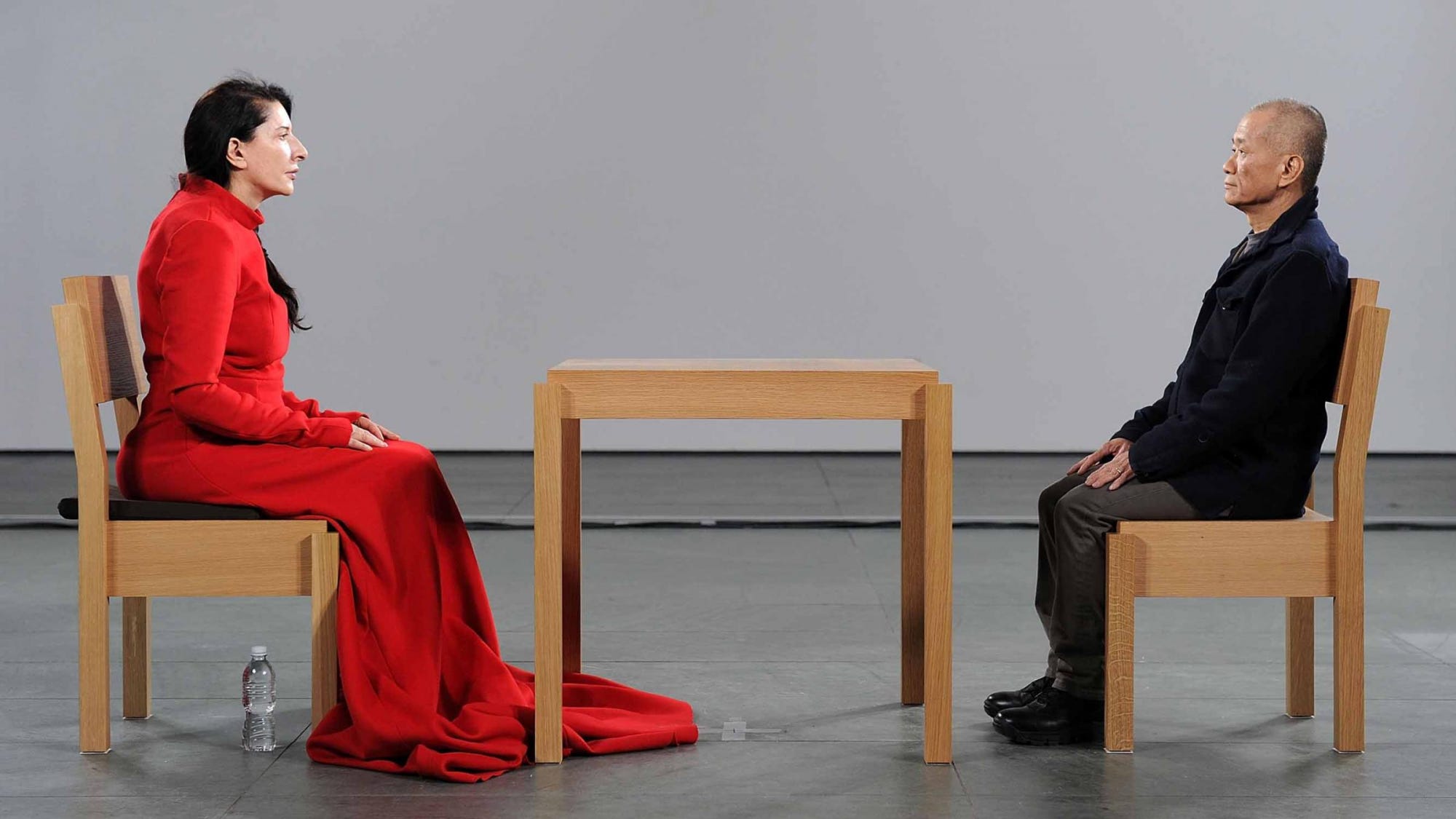
What happened in that space was neurobiology, meeting existential angst.
When we lock eyes with another person without distraction or defense, something profound occurs in our nervous system. Our mirror neurons fire, creating a literal neural resonance between two brains. We begin to perceive what the other person feels, not as interpretation, but as direct somatic experience. This is the biological foundation of empathy, and it requires something most of us rarely offer: sustained, undivided attention.
But there’s another layer at work here, one that French psychoanalyst Jacques Lacan saw as fundamental to identity itself. Lacan described the gaze, not as simple eye contact, but as the unsettling awareness of being seen and defined from the outside. We don’t only meet ourselves in the mirror; we come to exist as subjects through being looked at. The infant begins to recognize who they are by sensing themselves reflected in the mother’s face and attention. And as adults, the process continues: we keep seeking signs that we exist for others, that we matter.
In Lacan’s framework, the gaze is also bound up with power and desire. Who has the authority to look? Who is allowed to be seen? When Abramović sat motionless, offering herself up to the audience’s gaze, she disrupted the usual order. The viewers expected to watch, to consume, to stay invisible in their voyeurism. Instead, her steady presence turned the gaze back onto them. They were no longer detached observers, but subjects under scrutiny, revealed and implicated.
This is why people fled. Being truly seen means we can no longer hide in the anonymity of spectatorship. We’re confronted with ourselves as we appear in another’s field of vision. Not as the story we tell ourselves, but as we are in that moment. The comfortable distance between observer and observed collapses, and with it the illusion of neutrality. Suddenly, we’re part of the scene. We’re implicated.
In everyday life, we look at people. We glance, we scan, we assess. We formulate our reply before the other person finishes speaking. True seeing—the kind Marina Abramović invites—means setting aside our internal narrative long enough to allow another person’s reality to sink in. It means being open to being changed by the encounter.
Psychologically, it’s terrifying. To be truly seen means we can’t hide behind our carefully constructed personas. To truly see another human being means we must loosen our grip on the safety of our own perspective. It becomes an act of shared vulnerability that most relationships never quite reach.
What overwhelmed so many participants in The Artist Is Present wasn’t simply Abramović’s presence. It was the disturbing experience of being truly seen. Not assessed. Not managed. Not judged. Just recognized. For some, it may have been the first time another person offered that level of undivided attention. The tears weren’t about sadness; they were about finally being witnessed.
Attachment theorists call this attunement: having our inner state noticed and reflected back without distortion. Infants rely on it to build a coherent sense of self. Adults rely on it to feel that their lives matter to someone. When it’s missing, we feel a particular kind of loneliness—not just being alone, but existing unacknowledged, as if performing a life no one is really watching.
Abramović’s genius lies in recognizing that this hunger for recognition is universal and largely unmet. On stage, she created a container where the usual defenses—movement, chatter, distraction—couldn’t operate. What remained was the very thing we crave and fear the most: genuine contact.
Some visitors reported feeling rage. Others, profound peace. Many couldn’t articulate what happened, only that something shifted. This is because the experience operated at a level below language, in the realm of implicit memory and preverbal attachment patterns. Abramović wasn’t communicating with people. She was creating a relational field in which they could, perhaps for the first time, experience what it feels like to exist fully in another person’s awareness.
For a therapist, this matters. Much of therapy is helping people discover that they can be known and still be safe. That vulnerability isn’t annihilation. That the parts of themselves they fear won’t destroy the connection. The Artist Is Present offered a distilled version of that experience. The evidence that another person could hold space for someone’s full humanity without retreating.
We are meaning-making machines. We narrate ourselves into existence, constructing stories about who we are and why we matter. But beneath those narratives lies something messier: the reality that we’re fragile, contradictory beings, capable of tenderness and harm, sometimes in the same breath. Marina Abramović doesn’t resolve this tension. She amplifies it. She holds up a mirror and says, Look. This is what we are when the masks fall away.
This is what distinguishes performance art from spectacle. Spectacle distracts. Performance art demands participation, even if that participation is simply the act of witnessing. When Abramović cut a star into her abdomen with a razor blade in Lips of Thomas (1975), she wasn’t asking for applause. She was asking the audience to reckon with their own discomfort, their complicity in watching suffering without intervening.
The piece continued for over two hours—Abramović consuming honey and wine, lying on ice, flagellating herself—while the audience remained frozen in their seats. What unfolded was a stark demonstration of the bystander effect: the psychological phenomenon where people become less likely to help someone in distress as the number of other observers increases. Responsibility diffuses across the crowd. Everyone assumes someone else will act. But no one does.
The piece only ended when someone finally broke through the invisible barrier between performer and viewer to stop her.
That moment, the decision to act or not act, is where ethics and vulnerability collide. In our daily lives, we avoid these collisions. We numb ourselves with distraction, perfectionism, and the fantasy that if we just get our routines right, we can insulate ourselves from uncertainty. But uncertainty is the medium we’re made of. Every relationship, every creative act, every moment of genuine connection requires us to step into the unknown without guarantees.
Marina Abramović’s career can be read as an extended meditation on this fact. She has used her body as artistic material and subjected herself to exhaustion, pain, and public humiliation—not out of masochism, but out of a commitment to exploring the limits of embodiment, fragility, and finitude. Her work reminds us that the body isn’t merely a vehicle for the mind. It is the site where meaning is made, where emotion registers, where vulnerability becomes visible.
And this is where performance art does something language cannot. Words fail us constantly. They flatten experience, reduce complexity, and create the illusion that understanding equals resolution. But when you sit in a room with Abramović, when you feel your heart rate change under her gaze, when you realize you’re crying and don’t know why, that’s a different order of knowledge. It’s visceral, relational, and immediate.
This kind of knowing matters because so much of our psychological suffering stems from disconnection. From ourselves, from others, from the full spectrum of what we actually feel. Shame thrives in isolation. It tells us we’re too much or not enough, that our vulnerability is proof of deficiency rather than shared humanity. Performance art dissolves that illusion. It says, “We’re all exposed here.” We’re all capable of beauty and brutality. We’re all terrified and brave in equal measure.
What Abramović offers isn’t comfort. It’s recognition. She creates spaces where pretense becomes impossible, where the only option is to be present with what is. And presence—genuine, undefended presence—is the rarest and truest thing we have to offer each other.
So the next time you encounter a piece of performance art and feel the urge to dismiss it as self-indulgent, absurd, or shocking, pause. Ask yourself what you’re defending against. Because if art’s only job was to be pretty or palatable, we’d be living in a very different world—one where vulnerability was still mistaken for weakness, and being human meant never admitting we’re uncertain, vulberable, and afraid. Marina Abramović knows better. And deep down, so do we.