

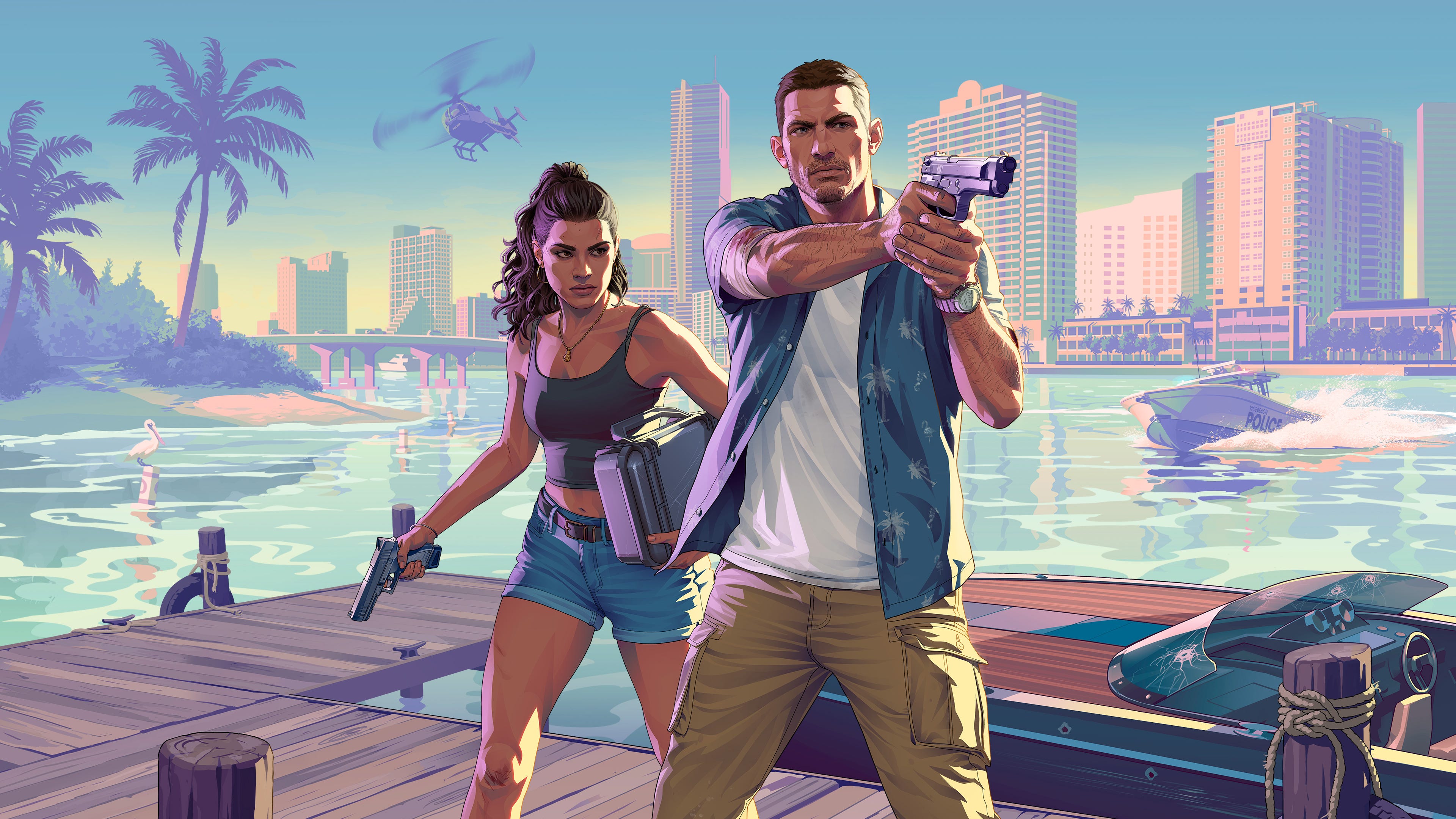
Millions of ordinary people are spending their evenings and weekends stealing cars, robbing banks, and shooting strangers. Their families needn’t worry too much. They’re doing it from the comfort of their sofas.
The long-awaited release of Grand Theft Auto VI on November 19 produced another astonishing commercial phenomenon. According to its publisher, Rockstar Games, the game generated an estimated $3.79 billion in worldwide retail sales on its first day, following 32.5 million copies sold before release. Apparently, crime does pay—at least for those selling the simulation.
The latest installment returns players to Vice City, GTA’s fictional Miami, and expands the setting to Leonida, an exuberant caricature of Florida. There are fast cars, extravagant mansions, beautiful beaches, criminal enterprises, conspicuous wealth, and enough dubious characters to fill several seasons of a Netflix crime drama. At the center are Jason and Lucia, a couple whose pursuit of a better life draws them into a sprawling criminal conspiracy.
The attraction is obvious. Vice City offers everything ordinary life tends to discourage: reckless adventure, instant gratification, limitless ambition, and the freedom to ignore other people’s expectations and rights. It’s a place where you can pursue wealth without worrying about business ethics, solve disagreements without a lengthy conversation, and steal a sports car simply because it’s fun and you don’t like walking.
But there’s a psychological contradiction worth examining.
Most people who enjoy these games have no desire to commit serious crimes. They value security, respect other people’s property, and would be horrified by the violence they cheerfully inflict on fictional characters. Yet they willingly pay to spend hours inhabiting a world built around behavior they would condemn in reality.
Are we witnessing the celebration of a nihilistic, morally bankrupt society? A harmless escape from the frustrations of civilized life? Or something more psychologically revealing?
Does playing violent games make us violent?
The controversy surrounding violent video games is almost as old as the games themselves. Every new generation of technology seems to bring a corresponding anxiety about what it might do to the minds of young people.
The underlying assumption is straightforward: repeatedly engaging in simulated violence must somehow normalize violence in the real world. The more convincing the simulation becomes, the more dangerous the consequences.
It’s an intuitively appealing argument. But intuition is a poor substitute for evidence.
After decades of research, the scientific picture is considerably less alarming than the public debate suggests. Some studies have found small correlations between violent games and aggressive behavior, typically measured through relatively minor expressions such as hostility, verbal aggression, or laboratory tasks. Whether these findings represent meaningful causal effects remains disputed.
In 2020, the American Psychological Association specifically cautioned against attributing serious violence, including mass shootings, to video games. The evidence simply doesn’t support such conclusions.
A 2019 study by Andrew Przybylski and Netta Weinstein, involving more than 1,000 British adolescents and assessments from their caregivers, found no significant association between violent gaming and aggressive behavior.
An earlier experimental study assigned adults to play Grand Theft Auto V, The Sims 3, or no game for two months. Researchers found no significant differences in aggression, empathy, or several other psychological measures between the groups.
These findings don’t establish that games have no influence on anyone, under any circumstances. Individual vulnerabilities, developmental differences, and patterns of excessive gaming still deserve attention. But they challenge the convenient idea that exposure to fictional violence transforms otherwise ordinary people into dangerous individuals.
There’s also something peculiar about singling out video games. Human beings have spent centuries enjoying stories about murderers, thieves, pirates, assassins, and ruthless kings. Shakespeare’s plays are populated by characters whose behavior would make a GTA protagonist look reasonably well adjusted.
The allure of fictional immorality is hardly new. What’s different about video games is that we don’t just watch the outlaw. We get to inhabit the role, make the choices, and experience the consequences in an increasingly realistic virtual world.
The more interesting question is what makes playing the outlaw so enjoyable.
The freedom to do what we cannot
Psychologists Andrew Przybylski, Richard Ryan, and Scott Rigby investigated this question in a series of six studies published in 2009.
Their findings were revealing. What predicted enjoyment was not primarily the opportunity to engage in violence, but the experience of autonomy and competence.
Players enjoyed having choices, exercising control, mastering challenges, and seeing their actions produce results. Violent content contributed relatively little additional enjoyment once those psychological needs were considered, although people with more aggressive dispositions showed a stronger preference for violent games.
Most of our waking hours involve negotiating limitations. We have jobs, financial obligations, family responsibilities, social expectations, and relationships that demand compromise. We cannot always say what we think, do what we want, or pursue every impulse that crosses our minds. Growing up is largely a process of learning to tolerate frustration and accept that our wishes are not commands the universe is obliged to follow.
Civilization depends on this capacity for self-restraint. So do successful relationships, careers, and communities.
But self-restraint comes at a psychological cost. We surrender possibilities. We learn that freedom has consequences, that other people have competing desires, and that gratifying ourselves cannot always take priority.
A game like GTA offers a temporary escape from these constraints.
In Vice City, you don’t have to consider whether you can afford the car you want. You can steal it. You don’t have to spend years building an enterprise. You can take over someone else’s. The distance between desire and action is compressed into a few buttons.
The pleasure isn’t necessarily in behaving criminally. It’s in experiencing a degree of freedom and control rarely available in real life.
Of course, GTA has rules of its own. The police pursue you, missions impose constraints, and your actions produce consequences within the game. But these are challenges to overcome rather than obligations to organize your life around. Failure costs you progress, not your freedom, reputation, or future.
We can experience danger without actually being endangered, exercise power without being accountable for its real-world consequences, and make reckless choices without destroying our lives.
The outlaw in our imagination
Psychoanalysis offers another way to understand this fascination, although its explanations should be distinguished from experimental findings.
Freud saw fantasy as an important means through which people give expression to wishes that cannot always be satisfied in reality. The child who plays at being a soldier, a king, or a monster is not necessarily expressing an intention to become one. Play allows us to inhabit possibilities without being bound by them.
English pediatrician and psychoanalyst Donald Winnicott developed this insight further. For Winnicott, play created a psychological space between inner experience and external reality, where we could experiment, imagine, and discover without the ordinary constraints of the world.
That distinction between imagining and acting is central to psychological maturity.
As a therapist, I often encounter people distressed by thoughts or fantasies they consider unacceptable. They assume that imagining something aggressive, selfish, or socially forbidden must reveal a hidden truth about their character.
But our mental lives are far more complicated than that.
A thought is not an intention. A fantasy is not a plan. An impulse is not a moral commitment.
We can imagine humiliating someone who has offended us without wishing to carry out the humiliation. We can enjoy a revenge fantasy while remaining perfectly capable of forgiveness. We can become absorbed in the exploits of fictional criminals without finding criminal behavior acceptable.
Psychological health doesn’t require the elimination of every unacceptable thought. It requires the capacity to recognize our inner experiences without automatically turning them into actions.
The appeal of GTA fits comfortably within this understanding. We can temporarily inhabit a personality that behaves in ways our ordinary selves would reject, exploring possibilities within a clearly fictional setting.
But we should be careful with the tempting idea that GTA functions as a release valve for repressed aggression.
The popular theory of catharsis suggests that expressing aggressive impulses in a harmless setting reduces our need to express them elsewhere. Unfortunately, research has not established that playing violent games reliably produces this effect.
In a study published in 2022, researchers found that habitual players often felt better after gaming and interpreted this improvement as evidence that they had discharged aggressive feelings. Yet improved mood did not necessarily correspond to reduced aggression.
Enjoying an aggressive fantasy can be entertaining, relaxing, or emotionally rewarding. That doesn’t mean the fantasy has cleansed us of aggression—or that we’re secretly aspiring criminals.
The curious morality of an immoral playground
One of the most revealing studies of GTA players comes from criminologists Jack Denham and Matthew Spokes.
They investigated the assumption that when people enter a virtual environment without ordinary social restrictions, they naturally surrender to their darker impulses.
The researchers observed 15 people playing GTA V and interviewed them about their choices.
The results were more complicated than the image of a lawless playground might suggest.
All participants engaged in violence at some point. But they also spent time driving responsibly, shopping, exploring, customizing vehicles, and pursuing mundane activities that would hardly qualify as criminal excitement.
Some displayed moral discomfort when the game pushed them toward particular acts of violence.
The study was small and qualitative, so it cannot tell us how most GTA players behave. Its importance lies elsewhere: it challenges the assumption that players automatically abandon their ordinary values when a fictional world gives them permission to misbehave.
Consider the irony. You enter a game where you can steal almost anything, attack almost anyone, and ignore conventional rules. And then you find yourself stopping at a red light.
Why?
Because morality isn’t simply a set of external restrictions imposed by society. Over time, its principles become part of how we perceive ourselves, other people, and the world.
We develop habits of restraint that do not disappear merely because punishment is unlikely. We carry our values into our imagination, even when we temporarily set them aside for entertainment.
There’s an important distinction between enjoying the opportunity to violate a rule and wanting to live in a world where that rule no longer exists.
Research also suggests that simulated immorality doesn’t always make us morally indifferent. A 2014 experimental study found that committing immoral acts in a video game could elicit guilt and make certain moral principles more salient.
It would be absurd to conclude that GTA is therefore a moral education program. But it’s equally simplistic to assume that simulating wrongdoing necessarily erodes our capacity to recognize it.
The american dream, without the rules
Vice City is not just a criminal playground. It’s a caricature of contemporary American society, with its worship of money, celebrity, status, physical appearance, and material success.
The game ridicules a culture in which almost everything has a price, wealth confers status, and personal success is measured through conspicuous consumption.
Yet it simultaneously allows players to enjoy the very excesses it mocks.
This is the peculiar genius of GTA. It satirizes the American Dream while offering players an extravagant, criminal shortcut to achieving it.
You can condemn greed while accumulating virtual fortunes. You can laugh at the absurdity of luxury culture while pursuing increasingly expensive possessions. You can recognize the emptiness of a world obsessed with status while enjoying your own rise through its hierarchy.
That doesn’t necessarily make the game an ideological celebration of capitalism or a sophisticated nihilistic critique of it. Its attraction comes partly from allowing both experiences to coexist.
We know that the relentless pursuit of wealth and status doesn’t guarantee happiness. We also know that having a beautiful mansion overlooking the ocean wouldn’t be entirely unpleasant.
GTA lets us enjoy the contradiction.
We don’t always seek stories that confirm our moral convictions. We are attracted to stories that let us experience the tension between what we believe, what we desire, and what we know we should resist.
The outlaw embodies this tension. He rejects the rules that constrain us, takes risks we would never take, and pursues rewards without accepting the ordinary costs. We admire his freedom while depending on the very social order he violates.
In other words, we can enjoy the outlaw precisely because we don’t have to live with him.
What our fantasies say about us
There’s a temptation to treat the enormous popularity of GTA as evidence of something troubling about modern society: a growing fascination with violence, moral indifference, or the celebration of selfishness.
But people’s enjoyment of morally questionable fiction tells us remarkably little, on its own, about how they will behave when confronted with real moral choices.
The more interesting psychological lesson concerns our complicated relationship with freedom.
Human beings need structure, security, cooperation, and predictable rules. Without them, social life becomes intolerable. But we also long for autonomy, excitement, novelty, and experiences that temporarily free us from the responsibilities that make civilized life possible.
These contradictory desires coexist in the same person. We can value peace while enjoying fictional conflict, respect the law while finding the outlaw irresistible, and behave responsibly while imagining a life in which responsibility no longer matters.
Imagination gives us room to explore these contradictions without having to resolve them through action.
Perhaps the remarkable thing about GTA is not how easily people become criminals when the rules disappear, but how much of their ordinary moral identity they retain even when invited to abandon it.
The pleasure of playing an outlaw doesn’t necessarily reveal a criminal hiding inside us. It reveals our appetite for freedom, adventure, power, and possibilities that ordinary life cannot always accommodate.
Being civilized doesn’t mean we never imagine breaking the rules. It means knowing the difference between a fantasy worth enjoying and a world worth living in.
Your point about people who value security paying to inhabit Vice City fits the self-determination research on games. Przybylski, Ryan and Rigby found that enjoyment tracked how well a game satisfied needs for autonomy and competence, and violent content added little once those were accounted for. For someone whose days are mostly obligations, the appeal may be the freedom from other people's expectations you describe. The crime is mostly the setting.