

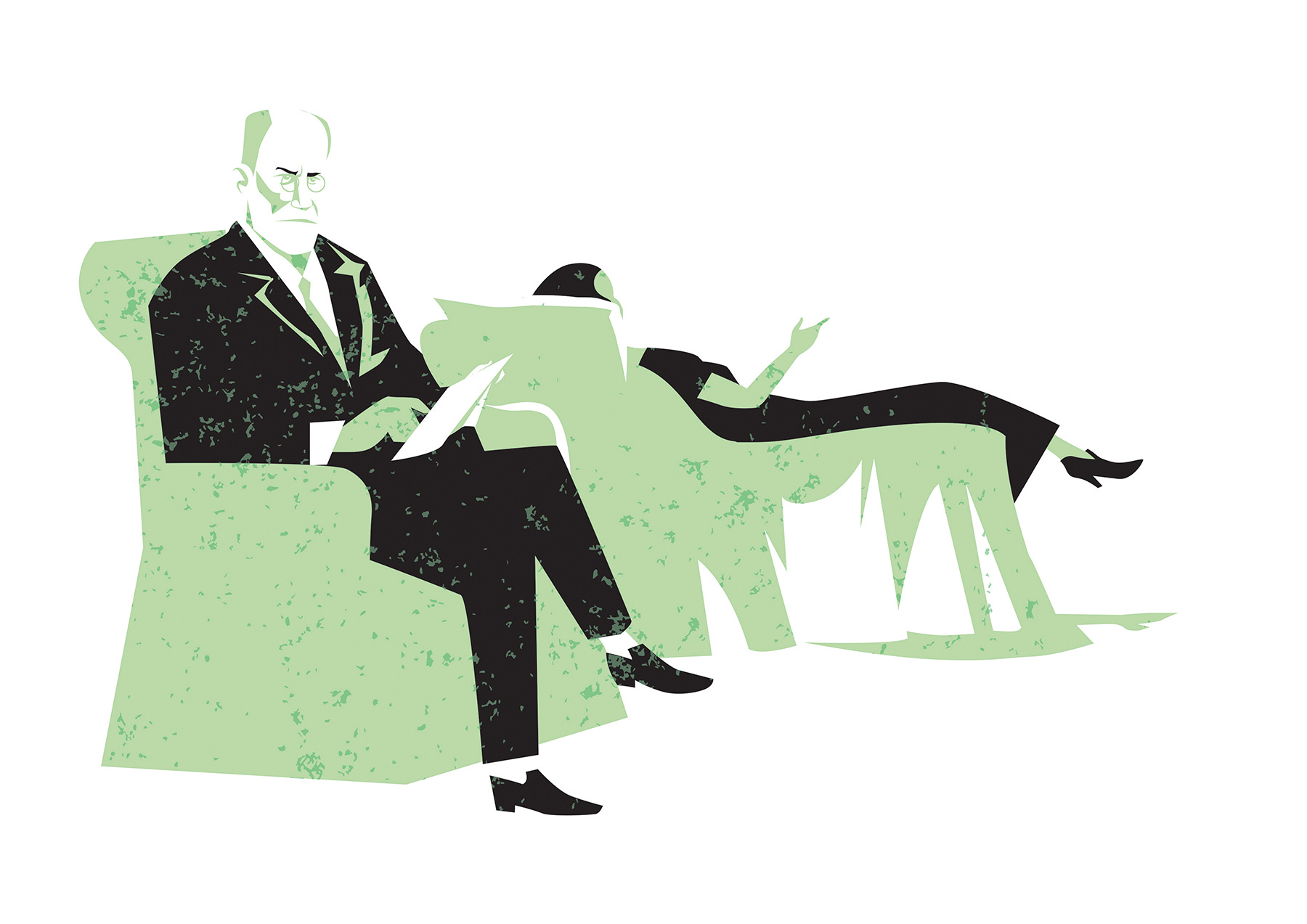
The standard narrative presented to undergraduate psychology students about Freud and psychoanalysis is structured like a morality tale, full of ironic and unpredictable twists and turns.
For half a century, the psychology community insisted that Freud’s ideas could never be tested, dismissing psychoanalysis as unscientific. Then, they rebuilt most of his theories from the ground up, giving the parts new names.
In 1934, Karl Popper published the general falsifiability criterion, writing that Freudian theories could accommodate any outcome and thus could not be used for prediction. After that, the couch was replaced by the lab, and the case study was replaced by the randomized trial. Freud was relegated to a chapter of intellectual history, to be read before the “real” science begins. Today, many university programs barely mention his name.
Yet, an ironic development has unfolded. While psychoanalysis was being escorted out of the building, researchers who weren’t interested in Freud—or who those would have been embarrassed to be caught reading him—arrived at his conclusions from the opposite direction.
Consider the unconscious. To a nineteenth-century Victorian ear, the term “unconscious mind” seemed an oxymoron: “unconscious” means the absence of awareness, while “consciousness” usually means subjective awareness. But in modern neuroscience, “unconscious processing” is a valid concept. The brain can perceive, evaluate, learn, regulate, and initiate responses without those processes entering conscious awareness. It is now unremarkable to say that the bulk of our cognition occurs outside of our awareness. No one credits Freud for this discovery, and in a sense, no one should. It was independently rediscovered by researchers studying priming effects and implicit learning.
Memory provides another instructive parallel. In 1896, Freud proposed that memory is not stored once, but rather transcribed repeatedly into separate systems that obey different rules. He believed that there must be at least three of these systems. He called these systems the conscious, preconscious, and unconscious. Cognitive science refers to these systems as short-term memory, declarative long-term memory, and non-declarative long-term memory and dates their discovery to the twentieth century.
The idea that early relationships shape personality, that childhood adversity increases vulnerability to disorder later in life, and that there are windows during which experiences are deeply imprinted has accumulated substantial empirical support. And almost none of it cites Freud.
The connection becomes even striking when we consider the concept of predictive processing. According to Karl Friston, the brain is constantly predicting what will happen next and adjusting when reality doesn’t align with those predictions. In this sense, a prediction can be understood as the expectation that a past experience will be repeated, especially one that was previously satisfying. Freud called this kind of expectation a “wish.” This similarity is not coincidental; both Freud’s ideas and Friston’s work on thermodynamics ultimately draw on Hermann von Helmholtz’s theories. Friston himself explored this connection in a 2010 neuroscience paper. In other words, these two very different theories of the mind share some of the same intellectual roots.
Even behaviorism incorporated Freudian motifs into its own idiom. According to the law of cause and effect, we repeat what is rewarding and avoid what is punishing. They chose the term “punishment” over “unpleasure” because “unpleasure” is not a feeling, and feelings were not permitted. Skinner called emotions fictitious explanations of behavior—a remarkable thing to write down while presumably experiencing several of them. Strip away the euphemism, and the law of effect becomes the pleasure principle without feelings.
A prediction that stopped updating
None of this would matter much to clinical work if it stayed at the level of headlines. It doesn’t.
In therapy, I see patients who can accurately describe the origins of their behavioral patterns. They know that they choose partners who are unable to commit. They can trace these patterns back to a parent, pinpoint when they began, and predict when they will end. Yet, they do it again. They have insight, but it changes nothing. This observation turns most people off to therapy. It’s also something the standard account of learning cannot explain. Knowing isn’t doing.
Reframed in predictive terms, repression stops being a metaphor for pushing things down. A child faces a problem with no good solution—a parent who withdraws unpredictably, for example—and builds the most acceptable prediction available. Ask for nothing and the parent won’t leave. That prediction gets consolidated into a defense mechanism that runs without awareness. Typically, a failed prediction comes back into consciousness and gets revised. These ones don’t. They keep firing, keep missing, and the mismatch resurfaces as negative feelings with no visible source. Patients say they don’t understand why they feel this way. They’re executing a strategy they can’t remember formulating, against conditions that ceased to exist decades ago. Symptoms such as depression, panic attacks, or obsessive-compulsive behaviors occur when that system fails to protect and fear resurfaces.
There is also a developmental reason some of these memories are unreachable. The declarative systems are immature through the first years of life, so everything learned in that window—including who to attach to and how—is stored in a form that cannot be recalled at all. Freud called it infantile amnesia and thought it was defensive. Part of it is simply maturational.
Non-declarative systems are subcortical, including the basal ganglia, amygdala, and cerebellum. They are action systems, not thought systems. You don’t think these memories; you perform them. This makes transference less mystical than it sounds. If enactment is the only way this class of memory can be remembered, then a patient who reenacts a childhood situation in therapy, casting the therapist in an unplanned role, is doing the only kind of remembering possible. The work is to catch that process in motion and make it contestable—to shift an action policy from systems that operate automatically to systems in which a person can think and choose. Imaging studies of patients following psychodynamic therapy show a clear shift toward prefrontal control. Compulsion becomes decision, which was always the point.
Where Freud was wrong
One of Freud’s central errors was not that he believed there was only one type of pleasure, but rather, that he grouped too many types of rewards into an extremely broad concept of sexuality.
For example, a sated infant continuing to suck could be seen as evidence of infantile sexuality because the sucking no longer served the purpose of satisfying hunger, yet it remained pleasurable. Thus, Freud classified the pleasure as sexual.
What Freud lacked was a sufficiently differentiated biology of motivation. Attachment, for example, is a motivational system in its own right with rewards and distress mechanisms that cannot be reduced to sexuality. Jaak Panksepp’s affective neuroscience theory proposes seven primary emotional systems: seeking, rage, fear, lust, care, panic/grief, and play. These systems exist alongside homeostatic drives, such as hunger and thirst. Freud himself repeatedly acknowledged that his theory of the drives was provisional and would eventually have to be revised by biology. Biology did revise it, although not in precisely the way he anticipated.
The more fundamental claim that survived is the load-bearing claim that organisms are moved not merely by information, but also by how things feel. Reward and aversion have causal power. No one buys drugs for the information they provide.
The question of therapeutic evidence also deserves a straightforward answer. Modern psychodynamic therapy, which evolved from psychoanalytic theory, is as effective as cognitive behavioral therapy (CBT) in short trials, partly because the trials are condensed into the same number of sessions. However, the difference becomes obvious during follow-up: CBT’s gains tend to fade and require significant regular reinforcement, whereas psychodynamic therapy’s gains either hold or continue to grow. This finding, like most therapy outcome findings, is contested. However, it’s not entirely absent, as continued improvement after treatment ends is what you would expect from addressing the root cause rather than merely suppressing the symptoms.
For thirty years, consciousness researchers have focused on vision and the cortex. But vision is precisely the wrong place to look because you can recognize a face or read a sentence without any awareness. Look deeper, to the brainstem systems that generate arousal and raw emotion, and the question changes. The actual oxymoron is a feeling you can’t feel.
Freud was ostracized by the psychology community for insisting that nature includes the subjective and for studying it anyway. He refused to adapt his approach to fit the subject. This refusal remains the discipline’s most intriguing problem.
https://ctmmindfulness.substack.com/p/the-third-eye-goes-further-than-hermeticism?r=718h5l Awesome article, I hope you read mine, it goes into feedback in a way that relates to what you talked about vision near the end.
Interesting how everything we categorize ultimately dissolves into the chicken and egg paradox.
"Look deeper, to the brainstem systems that generate arousal and raw emotion, and the question changes."
Is there any evidence the body-mind is the source of consciousness?