

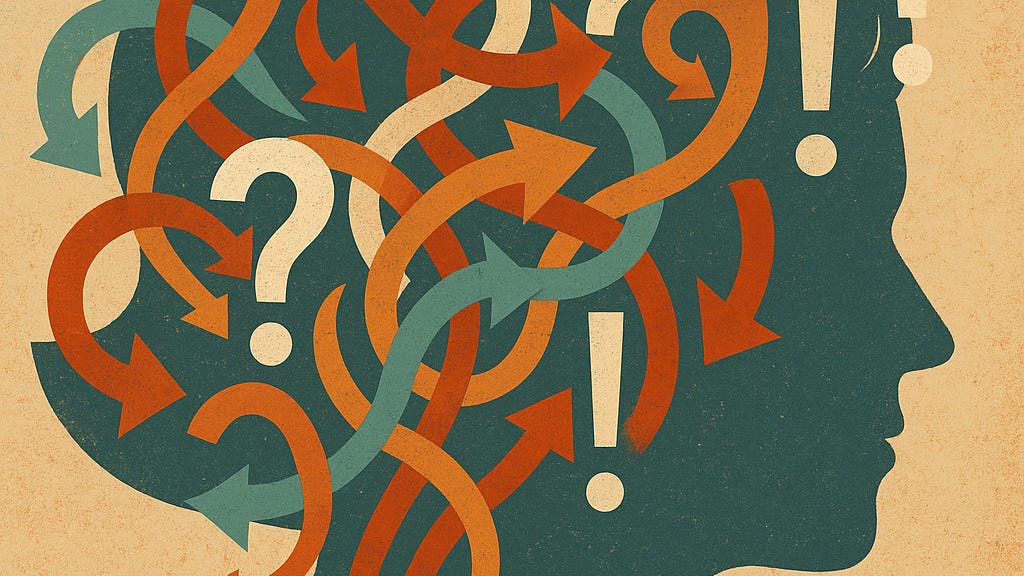
A good deal of what gets diagnosed as personal pathology has a social signature and a hundred-year-old name. The sociologist Émile Durkheim called it anomie.
Durkheim noticed something unusual in the late 19th century. Suicide rates climbed, not when life got harder, but when the rules of life got blurrier. Industrialization, urbanization, the collapse of traditional religion—these reshaped Europe so quickly that the old script no longer fit the new stage. He coined a word for the resulting condition: anomie. A form of normlessness. The malady of the infinite. The new ailment of a society without handrails.
Robert K. Merton picked up the thread in 1938 and made it sharper. He expanded the concept into Strain Theory, suggesting anomie arises when there is a mismatch between culturally defined goals and the legitimate means available to achieve them. Merton argued that anomie intensifies when a culture promotes a particular goal—financial success, the American Dream—while quietly closing off the legitimate routes to get there. The cultural foot stays on the gas; the institutional brake locks up. Strain follows. Merton sketched five ways people respond to this squeeze: conformity, innovation, ritualism, retreatism, and rebellion. Most field guides to modern life can be drawn from those five entries.
Innovation is the startup entrepreneur and the drop-shipper, but it is also the kid running a romance scam from a laptop. Same goal, different means. Ritualism is the employee who has stopped believing the job means anything but still files the report on time, the spouse who maintains the marriage as a sequence of obligations. Retreatism is the Hikikomori (severe social withdrawal) in Japan, the “Deaths-of-Despair” victim in Ohio1, the twenty-eight-year-old who has logged off life and lives inside a screen in his mother’s basement. Rebellion is the radical of any flavor who has decided the goals themselves were a con and proposes new ones, often with conviction calibrated to the previous emptiness. Conformity is the rest of us, mostly, carrying on as if the script still made sense.
Reading the news through this taxonomy is uncomfortable, because so much of what looks like a sudden eruption of individual dysfunction maps cleanly onto a structural strain that has been building for decades.
South Korea is now one of the clearest contemporary example of anomie. In two generations, the country compressed the West’s two centuries of industrial transformation into a single sprint. The result is the lowest fertility rate ever recorded in a modern nation, the highest suicide rate in developed countries, and a younger generation fed on K-Pop that has coined its own vocabulary for surrender—the N-po generation2, named for the growing list of life goals being given up in sequence (dating, marriage, children, home ownership, career, hope) . The Confucian script that organized Korean life for centuries is gone. The replacement is a brutal meritocratic contest few can win. The space between them is anomie at national scale, and the demographic numbers are what it looks like when a society stops reproducing the conditions for its own continuation.
Now, let’s discuss the clinical perspective. People walk into a therapist’s office and describe feelings of anxiety and low motivation, a sense of meaninglessness, confusion about their identity, and an inability to commit. They have read enough about psychology online to suspect that they have attachment-style wounds, ADHD, autism, or complex trauma. Sometimes these diagnoses are accurate. More often, however, the person sitting in the chair has an inner world that stubbornly reflects the chaotic reality outside. Their internal compass is broken because the magnetic field has shifted.
Five symptoms recur. The first is what Durkheim already named: an existential dread that grows in proportion to the menu of choices. When nothing is forbidden and nothing is required, no decision feels final and no achievement feels enough. The second is identity diffusion. A stable sense of self needs a social mirror that holds still long enough to show you a face. When the mirror itself keeps shifting—new platforms, new norms, new vocabularies every twelve months—the face never settles, and identity becomes fragmented. The third is the collapse of interpersonal trust. If we no longer share a moral grammar, every interaction starts as a negotiation rather than an exchange, and exhaustion follows. The fourth is impaired self-regulation. External norms function as scaffolding for internal control; remove the scaffolding and the building leans. Hedonism, nihilism and violence are predictable results, not character flaws. The fifth is learned helplessness. When effort no longer correlates with outcome in any visible way, a person stops trying. This becomes a diagnosis in itself.
There is a sixth response that is more dangerous because it feels like a solution. When faced with too much ambiguity, the mind reaches for radical certainty. Cults, conspiracies, authoritarian movements, and rigid, radical ideological scripts all sell the same product: relief from the unbearable lightness of having to choose. They restore the handrails. The price is that the handrails now belong to someone else, who gets to decide who counts as a person.
The clinical implication is awkward. A psychologist trained to locate suffering within the individual—in the early attachment, the cognitive distortion, the unprocessed memory—is not wrong, exactly. Those layers exist and matter. But the field can collude with anomie by inviting patients to treat a structural condition as a personal failing. The patient leaves with tools for managing what is, in part, a collective problem, and feels secretly worse for needing the tools.
This does not argue against therapy. It argues for honesty about what therapy can and cannot do. It can help a person build internal handrails when the external ones have rotted. It can clarify values when the culture refuses to. It can hold a stable mirror long enough for an identity to take a recognizable shape. What it cannot do is restore a moral consensus or rebuild the institutions that used to carry that weight. Pretending otherwise is part of the problem.
Durkheim and Merton were not pessimists. They believed that societies could rebuild norms and that anomie was a condition, not a fate.
The same is true of the people who bring their symptoms into therapy. There is no private island untouched by the broader unraveling, and no wellness routine to the rescue. The work is to recognize when a personal symptom is also a social one, to stop apologizing for being shaped by the world you live in, and to take whatever agency remains and use it. Agency does not require a quiet century. It only requires that you stop waiting for one.
Curated thematic reading suggestions
Anomie under late modernity
Christopher Lasch’s The Culture of Narcissism: the author saw most of this coming and named it well.
Zygmunt Bauman’s Liquid Modernity: supplies the vocabulary for why social mirrors won’t hold still anymore.
Charles Taylor’s The Ethics of Authenticity: the accessible entry to his larger argument that modern selfhood demands a coherence the culture no longer supplies.
Alasdair MacIntyre’s After Virtue: supports the philosophical statement of the “shared moral grammar has collapsed” claim.
Byung-Chul Han’s The Burnout Society, on South Korea’s decline.
Retreat into radical certainty
Erich Fromm’s Escape from Freedom: the canonical text on why people trade choice for handrails when the handrails are gone.
Eric Hoffer’s The True Believer: shorter, sharper, almost aphoristic.
Deaths of despair, deaths of meaning
Case and Deaton’s Deaths of Despair and the Future of Capitalism: the empirical American picture; useful because it refuses the individual-pathology frame.
Robert Putnam’s Bowling Alone: maps the underlying social-capital collapse.
Viktor Frankl’s Man’s Search for Meaning: despite being assigned everywhere, still earns an important place.
“Deaths of despair” is a term coined by the Princeton economists Anne Case and Angus Deaton in a 2015 paper and developed in their 2020 book Deaths of Despair and the Future of Capitalism. It refers to a specific cluster of mortality—suicide, drug overdose, and alcoholic liver disease—that began rising sharply among working-class white Americans without a college degree starting around the late 1990s, reversing a century of life-expectancy gains.
The N-Po generation refers to South Korean young adults (19–39) who are abandoning key life milestones—dating, marriage, children, employment, and homeownership—due to intense economic pressure, high living costs, and, crucially, housing insecurity in a highly competitive society. “N” represents an indefinite number, indicating that “numerous” things are given up. "The Relationship Between Types of N-po Generation...".
Thank you for your guidance on through which perspective my perceived short comings should be viewed. As a baby boomer I started my life journey in a rules based society with a strong, if biased, moral code. Now it seems there are different rules and vague learnt morals that make me feel like an outsider. Its hard enough dealing with changes in what is PC, because you can look at your own past actions as unacceptable, even though the bias mentioned earlier was not apparent at the time. I need to go deeper and ask do I accept newer generations have no morals or just flawed morals. At this point I remain confused, especially if there is no obvious answer in therapy. To whom do I turn. Plenty of opinions about right and wrong seem to lack tenable solutions
The loss of a shared metaphysical understanding is so painful. It seems all art now is ironic, no one wants to stand for anything because that risks excluding someone. So everyone is included and there is nothing real for any of us.
I look at the work of the old Baroque masters and it's clear their experience of the world was so full of meaning they were screaming it onto the canvas, bleeding onto it. Who believes in anything strongly enough to create like that anymore?